
"Shelf life" is how long a food stays safe and good to eat under normal storage. Traditional Indian achaar achieves a long shelf life without artificial preservatives by combining natural hurdles — salt, oil, acidity and sun-curing — that together slow spoilage (Leistner, 2000). Maatru Rasah achaar keeps about 12 months unopened, with no artificial preservatives.
The question worth asking about a jar
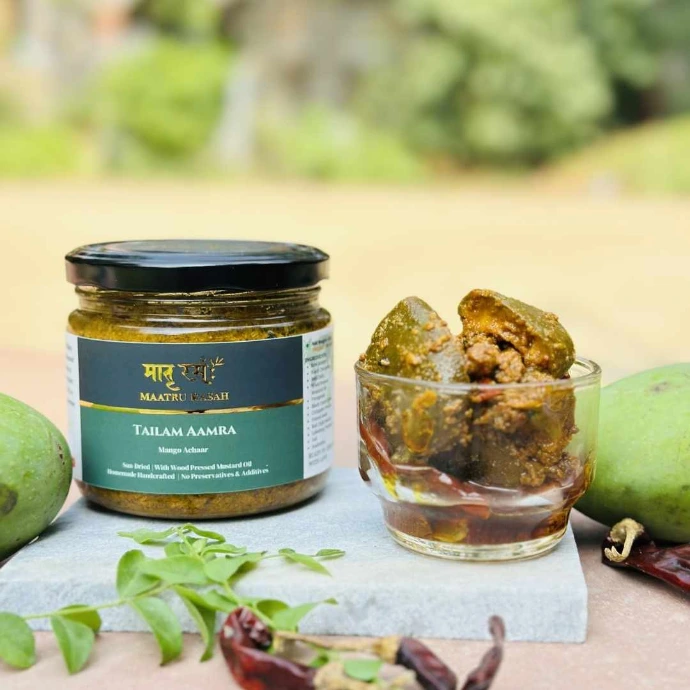
Most of us check one number on a food label: the expiry date. Far fewer ask the more useful question — what is keeping this safe to eat for so long? For some packaged foods the answer is added preservatives; for traditional achaar, the answer is a method older than any factory. This is a plain explainer of what "shelf life" actually means, how a jar of achaar keeps for months without artificial preservatives, and how we make ours. No fear, no health promises — just the food science and an honest account of our method.
What "shelf life" actually means
Shelf life is the period during which a food stays safe and keeps its expected quality — taste, texture, aroma — under normal storage. It is set by how quickly microbes (bacteria, yeasts, moulds) can grow and how fast the food's own chemistry (oxidation, moisture migration) degrades it. Anything that slows those processes extends shelf life. Preservatives are one way to do that. Salt, acidity, sugar, fat and drying are others — and they are far older.
What food preservatives are (the neutral facts)
Preservatives are substances added to food to slow spoilage and extend shelf life; in India their permitted use and limits are defined under the Food Safety and Standards (Food Products Standards and Food Additives) Regulations (Food Safety and Standards Authority of India, 2011). They have a legitimate, regulated role in the food system, especially for mass production, long transport and long storage.
We are not here to demonise them. Our choice not to use artificial preservatives is about method and scale — small, fresh batches sold within a sensible window — not a claim that approved additives are unsafe. That distinction matters, and we make it honestly.
How achaar keeps without artificial preservatives
Traditional achaar is a textbook example of what food scientists call hurdle technology — using several mild preservation factors together, so that no single one has to be extreme (Leistner, 2000). In a jar of achaar, the hurdles stack up:
- Salt draws water out of the vegetable and lowers the "water activity," the free moisture microbes need to grow. Less available water, slower spoilage.
- Oil (in oil-based achaar) seals the surface from air, limiting oxidation and mould. Wood-pressed mustard oil also carries naturally pungent compounds that discourage spoilage organisms.
- Acidity from the souring of raw mango and added spices makes the environment less hospitable to many microbes.
- Sun-curing and spices reduce moisture further and add compounds that help keep the achaar stable.
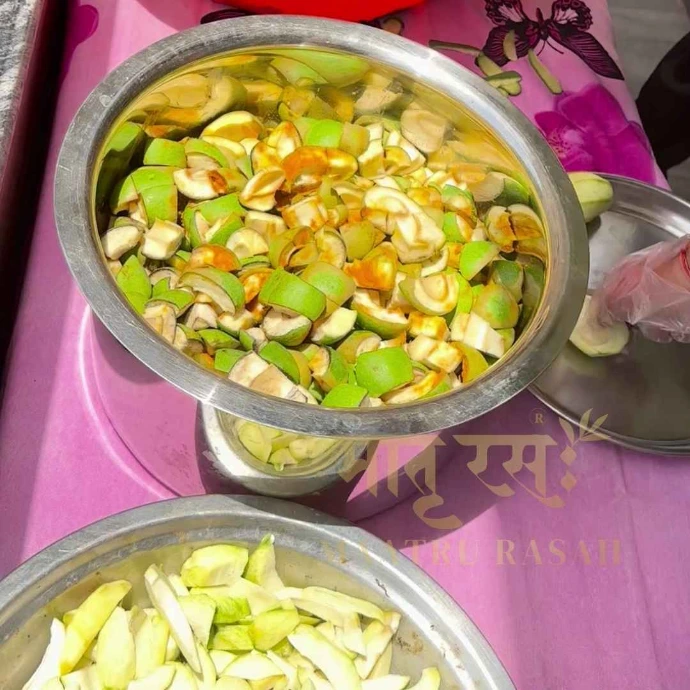
None of these is dramatic on its own. Together, they let a jar sit safely for months — which is exactly how Indian kitchens preserved food long before refrigeration or additives existed (Tamang et al., 2016).
How Maatru Rasah does it
Our approach is simple and we state it plainly:
- No artificial preservatives, colours or flavours. Preservation comes from salt, oil, acidity, sun-curing and spices — the traditional hurdles above.
- Small, fresh batches. We make in small quantities and sell within a sensible window rather than producing for indefinite shelf storage.
- Honest shelf life. Our achaar keeps about 12 months unopened, and about 6 months refrigerated after opening. We print real windows, not an indefinite promise.
- Seasoned and tasted by hand. Every batch is seasoned and tasted in our kitchen before it ships.
Preservative-free does not mean fragile. It means the jar relies on method and a realistic timeframe instead of additives — and on you storing it sensibly.
Watch: why traditional Indian pickles are made without artificial preservatives — the method, not a marketing line.
This is the same small-batch, preservative-free way we make every jar.
You can taste this method across our shelf — from the oil-based Tailam Aamra to the oil-free, vrat-friendly Phalahari Aamra. Browse the full Mango Achaar range.
How to store achaar so it lasts
- Always use a dry spoon. Moisture is the main enemy of a preservative-free jar; a wet spoon can spoil it.
- Keep oil-based achaar topped with oil. The oil layer protects what is below it.
- Store cool and dark, away from the stove's heat and steam.
- Refrigerate after opening for the longest life once the seal is broken.
Stored this way, the jar comfortably reaches the windows above.
An honest note
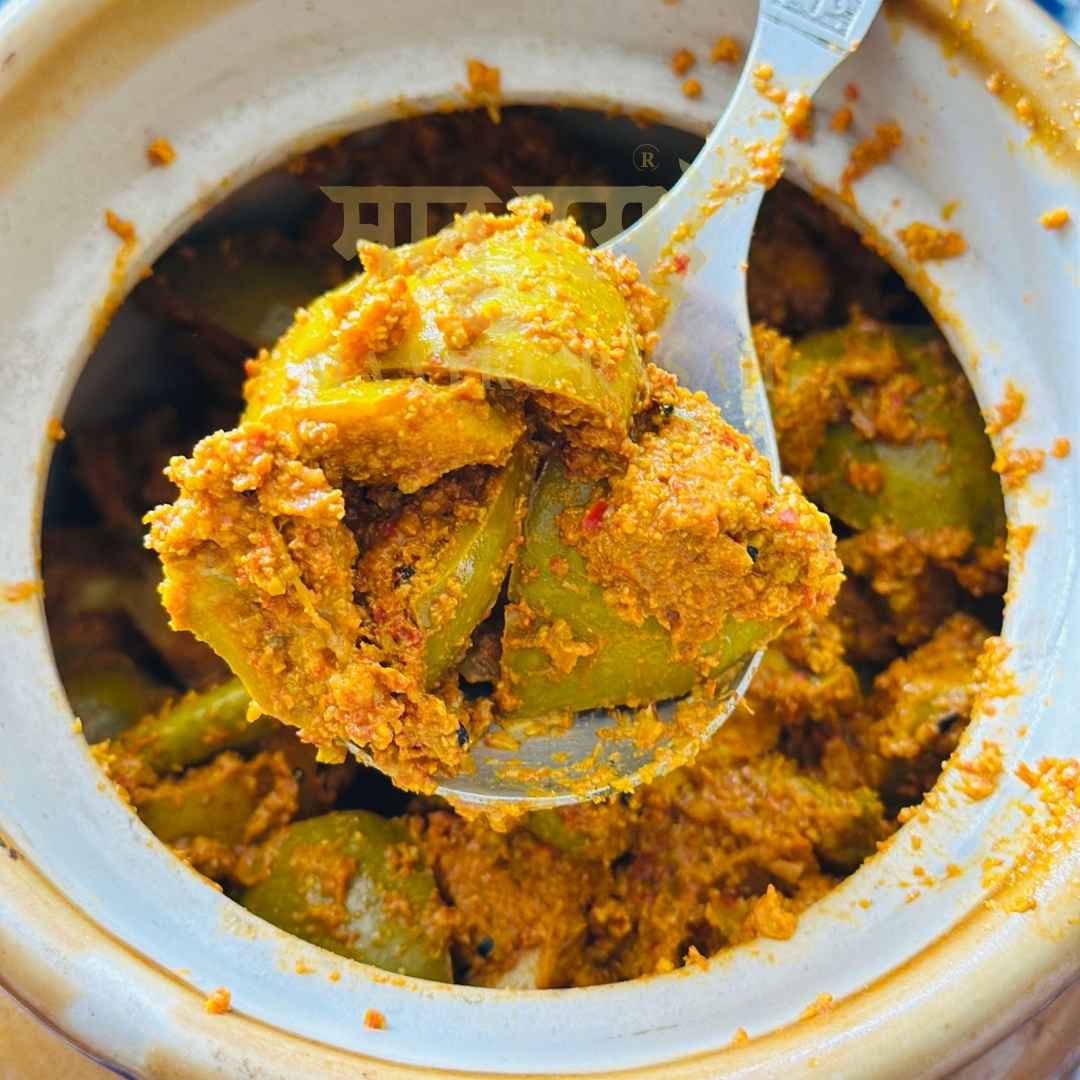
We are a small kitchen, not a laboratory, and we are careful about what we claim. We do not say that packaged food makes you ill, and we do not borrow a doctor's authority to sell achaar. What we can say is true and simple: we use no artificial preservatives, we make in small batches, and we tell you exactly how long the food keeps. The rest is your choice to make with clear information.
Frequently Asked Questions
Does Maatru Rasah achaar contain preservatives?
No. Maatru Rasah achaar contains no artificial preservatives, colours or flavours. It is preserved the traditional way — with salt, oil, acidity, sun-curing and spices — and made in small, fresh batches.
How long does preservative-free achaar last?
About 12 months unopened, and about 6 months refrigerated after opening. These are real storage windows; a preservative-free jar relies on sensible storage rather than additives, so always use a dry spoon and keep it cool and dark.
How does achaar stay safe without preservatives?
Through several natural hurdles working together — salt lowers available moisture, oil seals out air, acidity and spices discourage microbes, and sun-curing reduces water content. Food scientists call this hurdle technology (Leistner, 2000); Indian kitchens have used it for generations.
Is preservative-free food less safe?
Not when it is made and stored correctly. Safety comes from the preservation method and a realistic shelf-life window, not from additives. Approved preservatives are legal and have their place; our choice is traditional method plus small-batch freshness.
How should I store it?
Keep it cool and dark, use a dry spoon every time, keep oil-based achaar topped with its oil, and refrigerate after opening. Moisture is the main thing to avoid.
Disclaimer: This article explains food preservation and shelf life for general educational interest, drawing on cited sources. It is not medical or nutritional advice. Maatru Rasah products are foods, not medicines. For any health concern, please consult a qualified professional.
References
Food Safety and Standards Authority of India. (2011). Food Safety and Standards (Food Products Standards and Food Additives) Regulations, 2011. Ministry of Health and Family Welfare, Government of India.
Leistner, L. (2000). Basic aspects of food preservation by hurdle technology. International Journal of Food Microbiology, 55(1–3), 181–186. https://doi.org/10.1016/S0168-1605(00)00161-6
Tamang, J. P., Watanabe, K., & Holzapfel, W. H. (2016). Review: Diversity of microorganisms in global fermented foods and beverages. Frontiers in Microbiology, 7, 377. https://doi.org/10.3389/fmicb.2016.00377