— A 1857 FAMILY KITCHEN, STILL RUNNING
Heritage from 1857.
Made by hand
since 2013.
The story behind the jar — my mother's recipes, the 1857 kitchen they come from, and why we make so few.
FOUR GENERATIONS
FSSAI LICENSED
300–500 JARS /MONTH
— THE NAME
What "Maatru Rasah" means
Maatru Rasah is Sanskrit. Maatru means mother; rasah means essence, taste, or sap. Together it reads as a mother's essence — the taste of a mother's kitchen.
The name is the whole promise: food made the way a family cooks for its own, by hand, approved by one palate.
—OUR STORY
THE RECIPES · KATRA, PRAYAGRAJ
Cooked in one family kitchen since 1857.
Our recipes come from the Agarwal family kitchen in Katra, an old quarter of Prayagraj, where they have been cooked since 1857 and carried forward by four generations of Agarwal women. What was made there was what every prosperous Agarwal household made that century: achaars for the year ahead, sweets for the festivals, chutneys for the season.
Nothing was written down in any disciplined way. The recipes lived in the hands of the women who cooked them — taught the way such recipes are taught: at the stove, by watching, tasting, being corrected.
My mother, Uma Agarwal, turned fifty-two in 2013. On her birthday I asked her what she actually wanted now — not for the family, for herself. She thought for a long moment, then said:
THE PROMISE · 2013
"All these years, beta, I've cooked for you, for your father, for relatives who come and go. The food has lived only inside these walls. Now, at this age, I want to do something that's mine. I want people beyond our family to taste what we've always treasured. Maybe you could start a WhatsApp group? Perhaps a few things will sell."
UMA AGARWAL · THE WISH THAT STARTED MAATRU RASAH
A WhatsApp group. That was the size of the wish. She had cooked these recipes for more than three decades by then — mostly for us, sometimes for the gatherings a house like ours sees. I heard the wish and went to work, and the first commercial batches of achaar left the kitchen later that year. For eight years it stayed small and quiet — friends, family, WhatsApp orders. I launched the online shop in 2021 while I was still teaching, and in December 2024 I left my full-time academic post to give the kitchen my whole attention.
THE KITCHEN, TODAY · DELHI NCR
The recipes did not move. The location did. My mother cooks today in our Delhi NCR kitchen, with the women who have learned the kitchen from her — Neha, Neetu, and Sakshi — and the standards travelled with the recipes. The achaar that leaves now carries the recipe the Katra kitchen used in 1857 — written down with discipline at last, but cooked the same way. We claim the recipe lineage, not an 1857 company: the hands have changed across the generations, the recipes have not. My role was, and remains, to carry the kitchen into the world without changing what the kitchen does. The brand exists, in the end, to keep that line unbroken.
Maatru Rasah was founded in 2013 by Dr. (CS) Puja Shree Agarwal, daughter of Uma Agarwal, the kitchen's Head Cook; its recipes date to the family's Katra, Prayagraj kitchen of 1857.
— THE TWO WOMENBEHIND IT
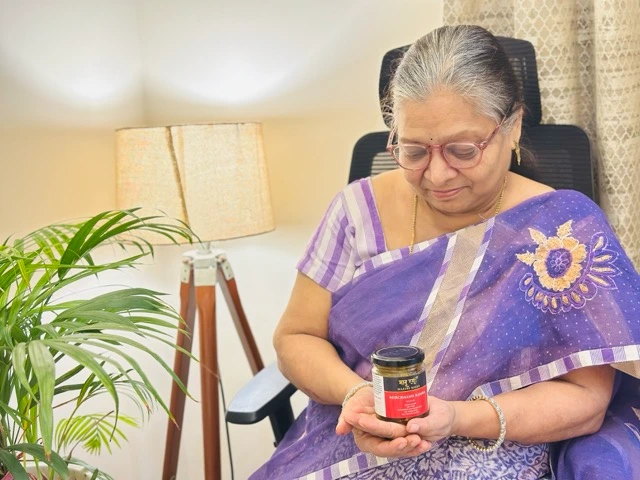
OUR INSPIRATION & HEAD COOK
Mother — Uma Agarwal
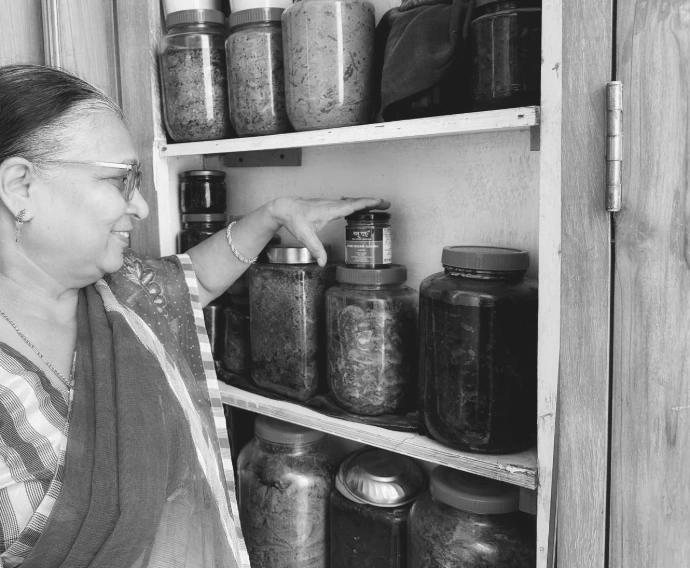
Uma Agarwal married into the Agarwal family in the early 1980s and learned these recipes from her mother-in-law over the years that followed — at the stove, by watching, tasting, being corrected. She has been cooking them for more than four decades. In 2013, on her 52nd birthday, she said she wanted to be self-dependent. Maatru Rasah was started so she could be. Today she seasons every batch of achaar before it leaves our kitchen. She tastes every jar of every product. She smells every grind of spice before it is bottled. The women who cook alongside her learned the kitchen from her, the way she once learned it. When she says a batch is ready, it ships. When she says it is not, it does not. Her judgment is the production standard.
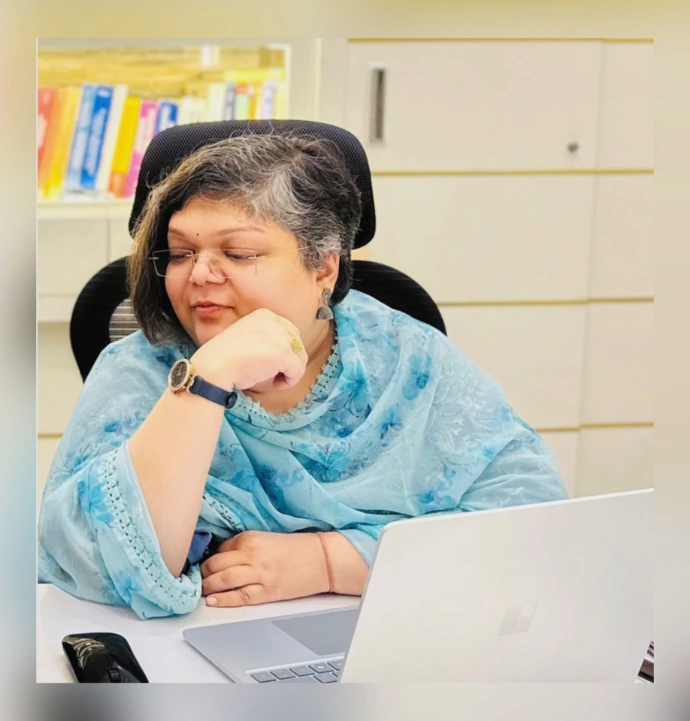
FOUNDER & DESIGNATED PARTNER
Dr. (CS) Puja Shree Agarwal
Dr. (CS) Puja Shree Agarwal is the founder of Maatru Rasah. She is also the daughter who started the brand in 2013 so her mother could be self-dependent. For eight years she ran Maatru Rasah quietly while teaching full-time. She launched the e-commerce platform in 2021 and left her full-time academic post in December 2024 to focus on the brand. She is the co-author of Heripreneur, a copyright-registered work on heritage entrepreneurship (Copyright Office, Government of India — Reg. No. LD-20260180878, registered 27 January 2026). She still teaches as a visiting faculty member. She replies to every customer email herself. You can write to her at care@maatrurasah.com.
Who makes the food?
Uma Agarwal is our head cook. She has made these recipes for more than four decades, and she seasons and tastes every batch before it ships, with a small team of women in our own kitchen. Nothing leaves without her approval. Her palate is the standard the whole kitchen is trained toward.
Her palate is the standard the whole kitchen is trained toward.
Uma Agarwal HEAD COOK
— OUR SOURCING · A PADMA SHRI GROWS OURTURMERIC
We came to her as researchers, not buyers.
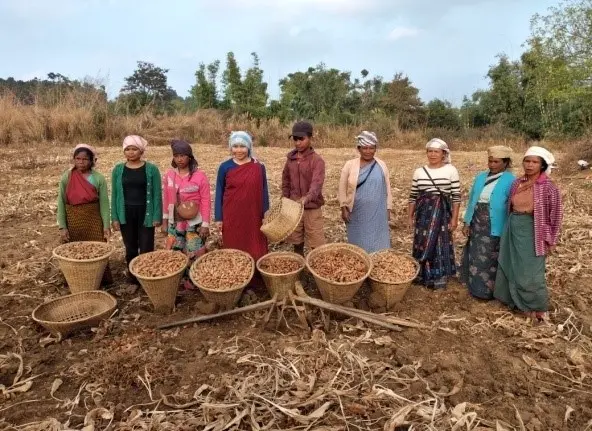
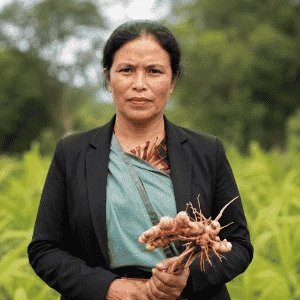
The Lakadong turmeric and Ing Makhir ginger we sell are grown in the Jaintia Hills of Meghalaya, through the organisation of Trinity Saioo. She is the Khasi farmer awarded the Padma Shri in 2020 — for organising more than nine hundred farmer households across the Khasi-Jaintia region. We do not buy from her farm. The cooperative does not work that way, and neither should we. We buy through her organisation, with documentation: invoices, signed agreements, traceability to specific farmers and specific harvests.
"I came to her as a researcher, not a buyer."
— Dr. (CS) Puja Shree Agarwal, on her first visit to Mulieh
Puja's academic fieldwork on heritage entrepreneurship in tribal India began in Mulieh village. She watched the curing, the slicing, the drying on bamboo mats. She asked the questions an ethics committee asks, not the questions a brand catalogue asks. The case study from that fieldwork is currently under peer review.
· Padma Shri, 2020 · 900+ farmer households organised · GI-tagged — 10.68% curcumin
Each batch we receive is lab-tested for curcumin between seven and twelve percent; our current Winter 2025–26 batch tests at 10.68 percent. We grind the turmeric in small lots in our Delhi NCR kitchen. Uma smells each grind before it is bottled. The Ing Makhir ginger comes from the same organisation — single-origin, GI-tagged. Both are Geographical Indication-tagged crops. The GI is held by the region, not by us. We respect that distinction.
We are not Trinity Saioo's only customer. Her organisation sells to several brands across India and abroad. What is unique to Maatru Rasah is not exclusivity. It is the documented depth of the relationship — the fieldwork that began it, the paperwork that sustains it. We do not claim what we cannot prove.
Our mustard oil is kachi ghani — cold-pressed, wood-pressed — at a traditional kolhu we have worked with for years. Mustard oil is the soul of north Indian achaar; the chemistry depends on it being pressed cold so the pungent compounds survive.
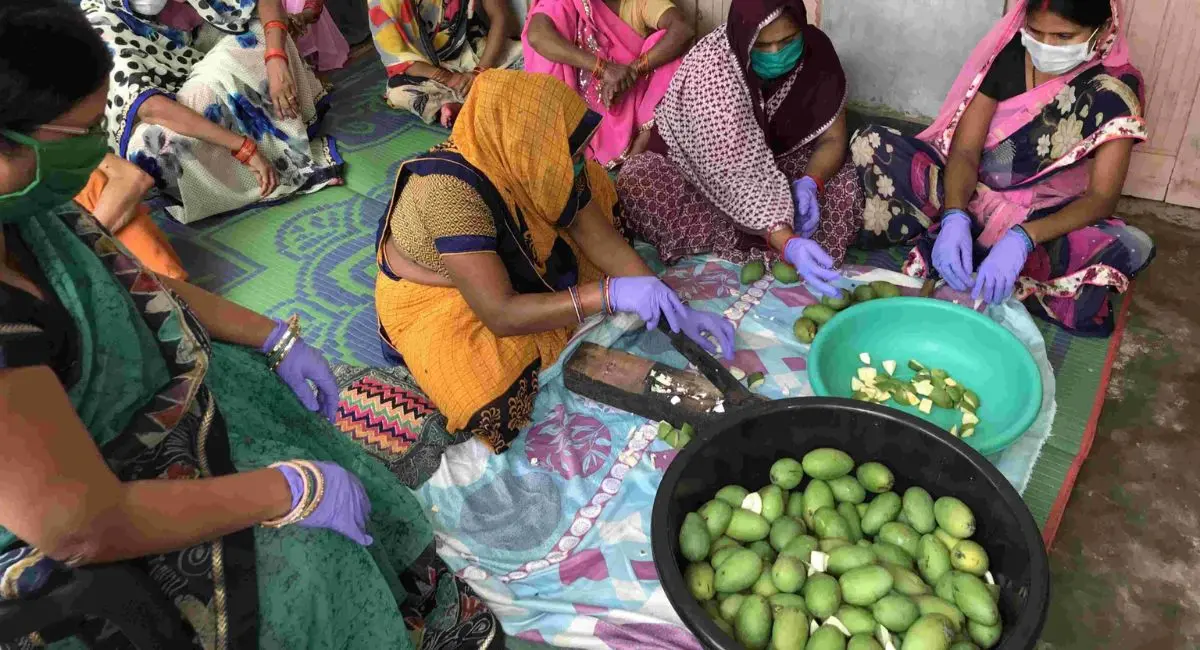
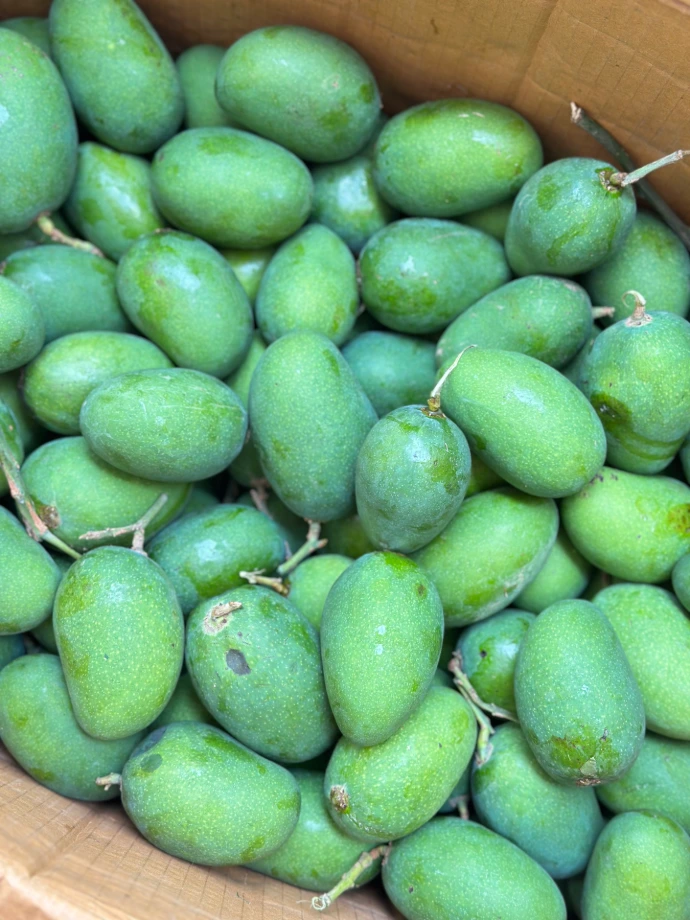
For our seasonal Aam Ka Achaar we match the mango variety to the recipe, not the season — Ramkela kairi for the long mustard-oil cure, chosen for tartness and firmness, sourced by variety from growers across northern India. The achaar is made in one production run a year; that is the supply for the next twelve months.
For wheat flour, jaggery and ghee we work with smaller relationships built over years. We do not buy on commodity markets and we do not run reverse auctions. If you want to verify any sourcing claim, write to me at care@maatrurasah.com and I will introduce you to the partner directly.
— HOW A JAR IS MADE
From raw material to a sealed jar — every step by hand.
The Raw Material
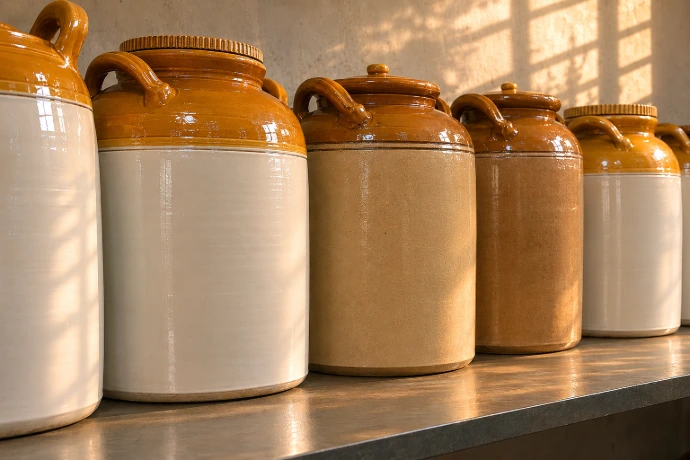
Before a jar is filled, it has to begin somewhere. Our mangoes come from orchards across northern India, picked once a year, the variety chosen to suit each recipe — the khatta-meetha Mango Chundu takes Kalmi aam, whose tartness holds against the syrup. The variety is chosen by what the recipe needs, not by what the season pushes onto the shelf. Our mustard oil is wood-pressed at a traditional kolhu, by a family we have worked with for years. Our turmeric and ginger come through Padma Shri Trinity Saioo's organisation in Mulieh village, West Jaintia Hills District, Meghalaya — each batch paid for, documented, traceable to specific farmers and harvests. The salt is unrefined sea salt. The water that touches the food is filtered; the water that washes the vessels meets FSSAI standards. The vessels — chini mitti barnis for curing, glass jars for shipping — are washed, sun-dried, and inspected before use.
The Making
Each batch is fifteen to twenty kilograms of fruit or vegetable — the size at which Uma can taste the masala by smell and adjust if the season has changed. Some achaars are cured in mustard oil; some in salt and sun alone. Our khatta-meetha Mango Chundu sits in its own self-made syrup for twenty-one days in a chini mitti barni, on a sunlit terrace, the lid weighted with a clean stone. Tailam Aamra cures for the same window in wood-pressed oil. Each recipe has its own clock, and the clock does not move faster because we wanted to ship sooner.
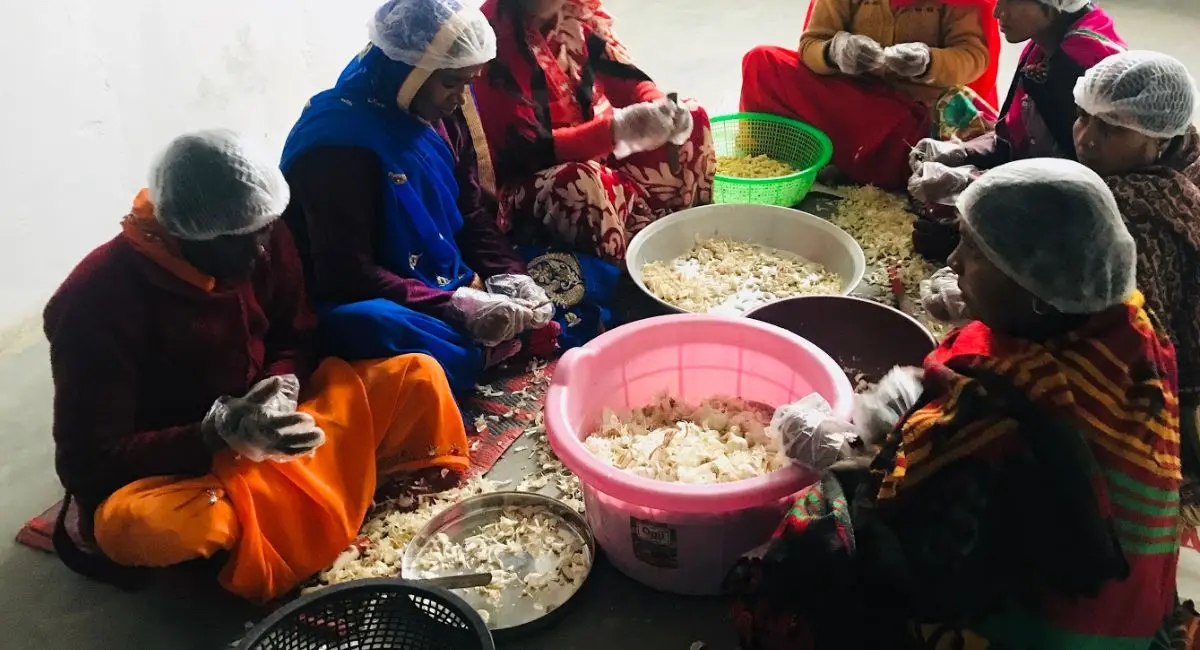
Uma seasons every batch and signs off on every batch. The jars are filled by hand, capped, weighed, batch-coded, and sealed only after she has tasted the day's work. We do not subcontract a single step. We do not run a parallel facility. There is one kitchen in Delhi NCR, and what leaves it that month is what we made that month.
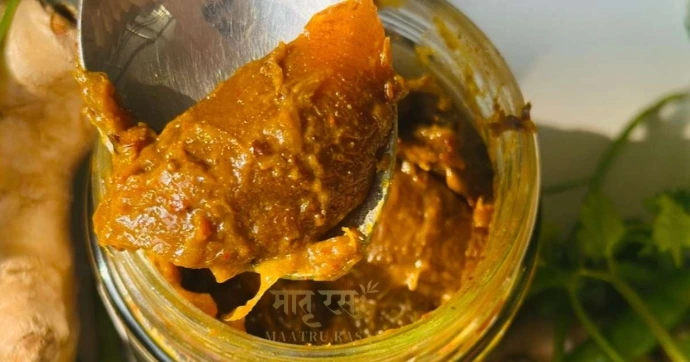
That method is what sets our ceiling — three hundred to five hundred jars a month, across every achaar, chutney, and sweet we cook. It is a structural choice, not a target to grow past: beyond it the kitchen would need contract manufacturing, automated filling, or recipe shortcuts, and none of those would preserve what we are preserving. The day that requires machinery is the day we stop growing. FSSAI License No. 12723052000504.
The day that requires machinery is the day we stop growing.
HOW SMALL WE REALLY ARE
When a batch finishes, the next one is weeks away.
We don't ship outside India yet — we'd rather stay small and honest than ship and apologise
JARS A MONTH · TOTAL · BY HAND

300–500
A WORD WE COINED
Bhartiya Heripreneur
heritage + entrepreneur · from "Heripreneur", a copyright-registered work on heritage entrepreneurship
The term comes from Heripreneur, a literary work co-authored by our founder Dr. (CS) Puja Shree Agarwal and registered with the Copyright Office, Government of India — Registration No. LD-20260180878 (Diary No. 25706/2024-CO/L; filed 14 August 2024; registered 27 January 2026). As with everything on this page: a claim you can verify, not a phrase we decorate with.
We call ourselves Bhartiya Heripreneurs. It marries enterprise with the reverence our heritage deserves. Beyond the food, we bring GI-tagged Indian crafts and paintings from artisan partners into homes that value them — the same principle as the kitchen: named makers, real provenance, nothing mass-produced.
— THE PEOPLE WHO MAKE THIS WORK
Maatru Rasah is the work of three named individuals you can look in the eye on this page, two more partners who run the business with us, an advisor we trust, and the kitchen team in Delhi NCR who cook alongside Uma.

Uma Agarwal
Head Cook & Heritage Custodian


Nitesh Dixit
Co-Founder & Designated Partner
Three more people shape the work behind the scenes. Neha leads the brand's outward face: social media, marketing, every message that goes out to the customer. Neetu is the brand's product advisor, the second pair of eyes on every recipe and every catalog choice. Rishabh Agarwal, an IIM Calcutta alumnus and supply-chain specialist, advises on the production side. His counsel, and our rule because of it, is that the manual process must stay. Automation is what we are not.
The Delhi NCR kitchen team is small and stable. The women have been with us long enough to know which masala bowl is which by smell. They do not appear on this page because that was their preference. The work is named even when the names are not.
OUR PHILOSOPHY
Most food is built to outlast you on a shelf. Ours is built to be eaten while it's still close to the hands that made it. We preserve achaar the way Uma learned it from her mother-in-law — salt, mustard oil, sun, and time, nothing a kitchen didn't have before 1950. Stored well, it improves as it sits: the kairi settles into the oil, the spices deepen. The date on our jar is shorter than the supermarket's, on purpose — we would rather you finish it fresh than keep it for years. We measure self-life, not shelf-life.
We measure self-life, not shelf-life.
WHY WE KEEP DOING THIS
Maatru Rasah exists to prove that India's heritage culinary traditions can survive on their own terms — made by hand, in a real family kitchen, with no artificial preservatives and no industrial shortcuts, from recipes the Agarwal family has cooked since 1857. The brief has not changed since 2013, and it will not change.
THE BRIEF HAS NOT CHANGED SINCE 2013, AND IT WILL NOT CHANGE
— WHAT CUSTOMERS SAY
We do not display every review we receive. The selection below is a small set, chosen because each one captured something specific — about a taste, a moment, a place where a jar landed. The full review history sits on our Google Business profile. We show these without star ratings, because stars do not tell anyone what a jar tastes like. Names and cities appear with each customer's permission.
Read more on our Google Business profile
"Maatru Rasah feels less like a brand and more like a philosophy.I ordered the Ing Makhir Ginger and Tailam Aamra Mango Achaar, and both reflect exceptional care and authenticity. no preservatives, no plastic, ethical sourcing. I feel confident keeping this in my kitchen & Will definitely order again. 👍"

"Absolutely loved the Maatru Rasah products! The quality feels pure, natural, and truly authentic...."

"I ordered tailam mango pickle and bitterguard pickle and got sample of khatta meetha mango pickle all turns out to be so good and mouth lickering that i am ordering this sample pickle again. All type variety is soo delicious and fresh that you will end up eating it again nd again in every meal."
"I ordered lakadong tumeric and mango pickle was amazing I am using it regularly. Thanks maatru Rasah for providing natural product in our lives."

"I recently tried the pickles and they are absolutely delicious! 😋 The Chuhara rasah & Khatta meetha is my absolute favourite - the perfect blend of spices and tanginess has hooked me! 🤩 I'd highly recommend giving it a try, you won't be disappointed! 👍👌"

"I have been using Maatru Rasah products for past one year and I have to say their pickles and gi tag lakadong turmeric are superb and amazing. The taste is completely homemade no artifical flavour. On every purchase they send samples also which i really love. A trustful brand for homemade pickles and spices."

—WHAT WE REFUSE
The brand's clearest statements are its refusals. These five rules have stayed unchanged since the kitchen began commercial work in 2013.
No machinery beyond basic kitchen tools.
No artificial preservatives. Nothing ending in -ate, -ite, or -ide.
No contract manufacturing and no outsourced filling.
No false marking — we never use a word we cannot prove.
No health claims. We describe taste and provenance; the health story is yours to draw.
— FREQUENTLY ASKED QUESTIONS
Asked Questions about Maatru Rasah
What does "Maatru Rasah" mean?
Maatru Rasah is Sanskrit — maatru means mother, rasah means essence or taste. Together: a mother's essence, the taste of a mother's kitchen. The name is the promise behind every jar: food made the way a family cooks for its own, by hand, approved by one palate.
Who is the founder of Maatru Rasah?
Dr. (CS) Puja Shree Agarwal founded Maatru Rasah in 2013. A company secretary and academic, she started the brand so her mother could be self-dependent, ran it quietly for eight years while teaching, and left full-time academia in December 2024 to focus on it. She replies to every customer email herself.
Who cooks Maatru Rasah's food, and who approves each batch?
Uma Agarwal, our head cook, has made these recipes for more than four decades. She seasons and tastes every batch before it ships, with a small team of women in our own kitchen. If she does not approve a batch, it does not leave.
Who is Trinity Saioo?
Padma Shri Trinity Saioo is a turmeric farmer from Mulieh village, West Jaintia Hills District, Meghalaya, awarded the Padma Shri in 2020 for organising more than 900 farmer households. Our Lakadong turmeric and Ing Makhir ginger come through her organization — 7 to 12 percent curcumin across batches (current Winter 2025–26 batch: 10.68%), GI-tagged.
Where is Maatru Rasah made?
Made by hand in our own kitchen, in small batches, from recipes that began in Katra, Prayagraj, in 1857. We cap production at three hundred to five hundred jars a month — total. When a batch finishes, the next one is weeks away.
What is the 1857 story?
The recipes began in the Agarwal family kitchen in Katra, Prayagraj, in 1857, carried by four generations of women. Maatru Rasah, the brand, was incorporated in 2013 by Dr. Puja Shree Agarwal. We claim the recipe lineage — not an 1857 company.
What is a "Heripreneur"?
Heripreneur — heritage + entrepreneur — describes an entrepreneur who builds a living enterprise around inherited cultural heritage: recipes, crafts, and provenance carried across generations, run commercially without breaking the tradition that makes them valuable. The term comes from a copyright-registered work co-authored by our founder, Dr. (CS) Puja Shree Agarwal (Reg. No. LD-20260180878, Copyright Office, Government of India). Maatru Rasah calls itself a Bhartiya Heripreneur venture: recipes from 1857, run as a deliberately capped, hand-made business since 2013.
If you have read this far,
either we have made our case, or we have not. If we have, the rest of what we make sits on our shelf. If we have not, write to us at care@maatrurasah.com— we read every message that flags a contradiction between what we say and what we do.
The recipes are from 1857. The work is done by hand. The rest is yours — take the jar, open it, share it, judge it.
Explore the Heritage Collection →
Founder & Designated Partner, Maatru Rasah
Nurture Our Community
Taste of Hand-Crafted tradition of India