
Turmeric adulteration is a real problem: powders have been found cut with starch or chalk, brightened with the banned dye metanil yellow, or coloured with toxic lead chromate (Forsyth et al., 2019). Simple home tests can flag some of these, but they are not definitive. The only reliable checks are laboratory testing and transparent, traceable sourcing.
A golden powder, and a quiet problem
Turmeric is in almost every Indian kitchen, and most of us never question what is in the tin. We should. Because the same colour that makes turmeric desirable also makes it easy to fake — and some of the fakery is not just dilution, it is genuinely unsafe.
This is a plain, honest guide: what adulterated turmeric actually contains, which kitchen tests are worth doing (and which ones quietly mislead you), and what really separates pure turmeric from the rest. No scare-selling, and no health promises — just how to know what you are buying.
What "pure turmeric" actually means
Pure turmeric powder is one ingredient: dried, ground Curcuma longa rhizome, and nothing else. Curcumin is the natural pigment that gives it colour (Hewlings & Kalman, 2017); good turmeric needs no added dye, no filler and no preservative. So "pure" here is simple — it means the powder is turmeric, all the way down. Adulteration is anything added to stretch the weight, fake the colour, or cut the cost.
What adulterated turmeric is really cut with
Three problems show up most often:
- Lead chromate (the dangerous one). Some turmeric has been coloured with lead chromate, an industrial pigment added purely to brighten dull powder. Lead is toxic, and researchers have traced lead-chromate-adulterated turmeric across South Asian supply chains (Forsyth et al., 2019). This is a safety issue, not a quality quibble.
- Metanil yellow. A synthetic textile dye, banned in food in India, sometimes used to fake a rich yellow. It is detectable with a simple acid test (see below).
- Starch, chalk and spent turmeric. Cheaper fillers — rice or tapioca starch, chalk powder, or "spent" turmeric (rhizome from which colour has already been extracted) — bulk up the powder and dilute it.
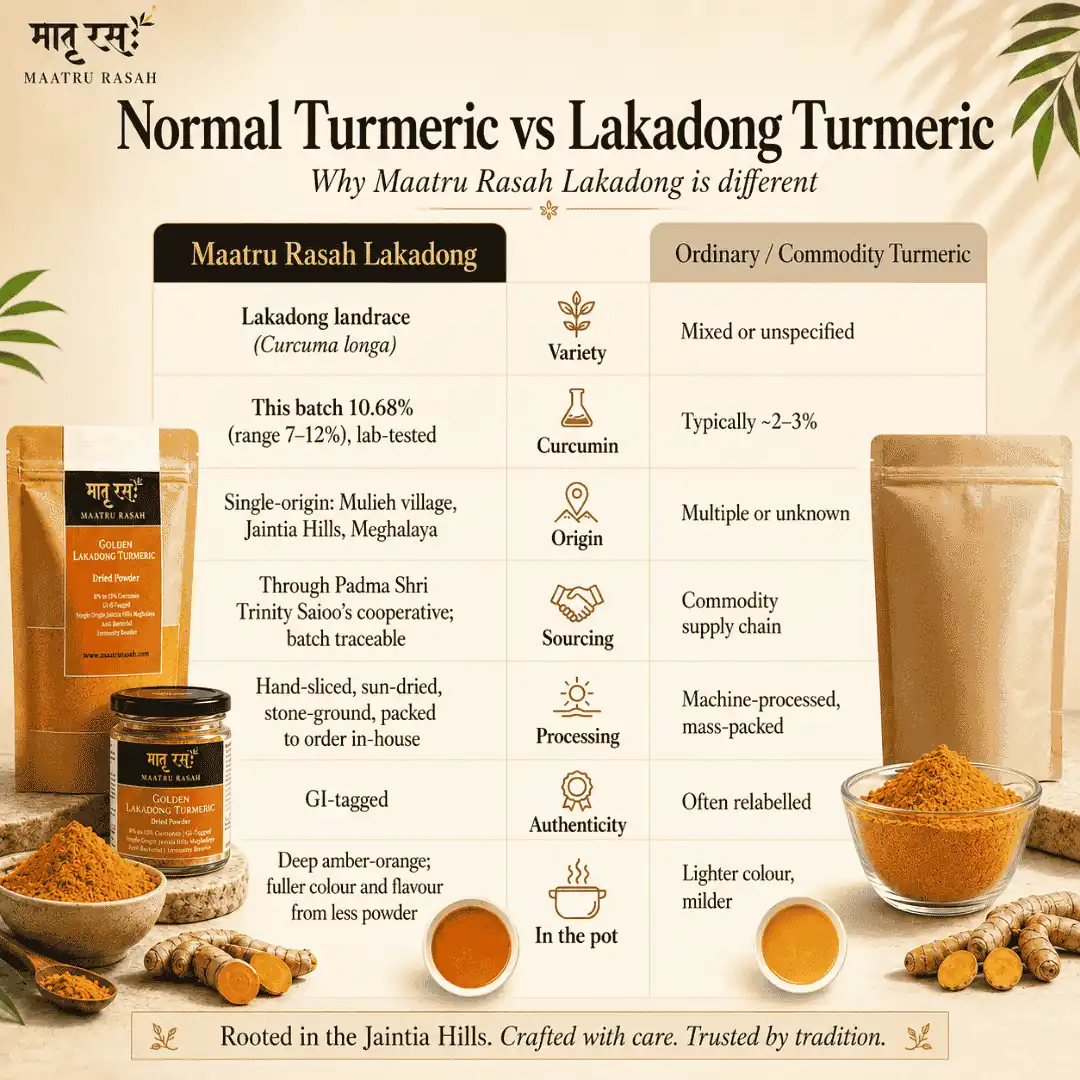
The first is a health hazard; the others are a quality and honesty problem. Both are reasons to care where your turmeric comes from.
Home tests — what they can and can't tell you
India's food regulator publishes simple kitchen tests in its DART manual (Detect Adulteration with Rapid Test) (Food Safety and Standards Authority of India, n.d.). The useful, evidence-based ones:
- Metanil yellow — the acid test. Mix a little turmeric in water and add a few drops of hydrochloric acid (or strong lemon/acetic acid as a rough proxy). A bright pink or magenta colour that stays suggests metanil yellow. Pure turmeric does not turn pink this way.
- Chalk — the fizz test. Add a few drops of strong acid to the powder. Visible effervescence (fizzing) points to chalk (calcium carbonate).
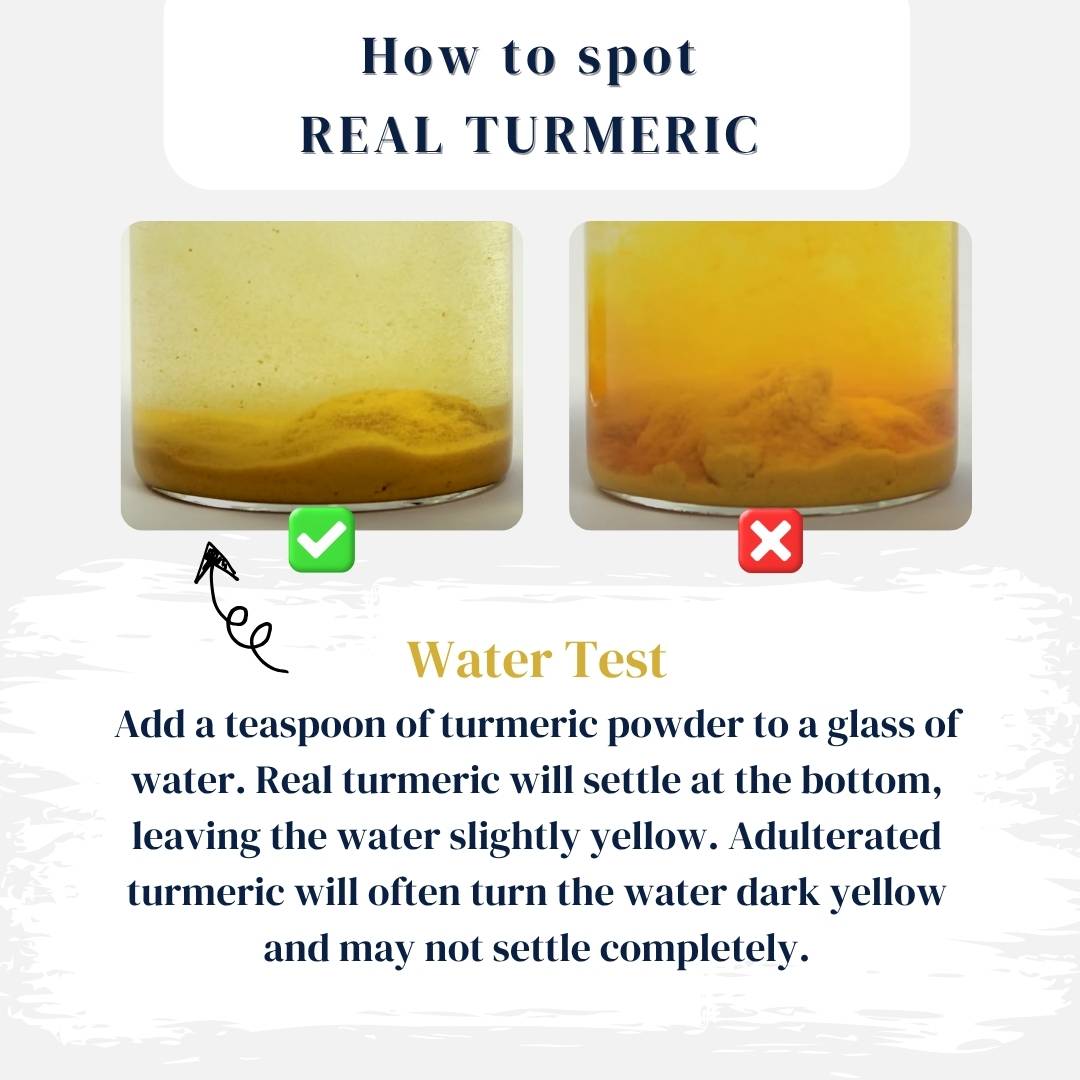
- Lead chromate — the water-shake. Stir turmeric into a glass of water. Lead chromate tends not to dissolve and can settle as a separate coloured layer or leave streaks. This is a flag, not a verdict.
The honest limit (this is where most "purity test" articles mislead you)
The popular claim that "pure turmeric settles and leaves only a light yellow water, so if your water colours strongly it's fake" is not reliable. Pure turmeric also colours water and settles — that is what curcumin does. A home test can raise a red flag, but it cannot certify that a powder is pure, and it cannot measure curcumin content at all. Anyone who tells you a glass of water proves purity is overselling it.
What actually guarantees purity
If the kitchen tests are only indicative, what is dependable?
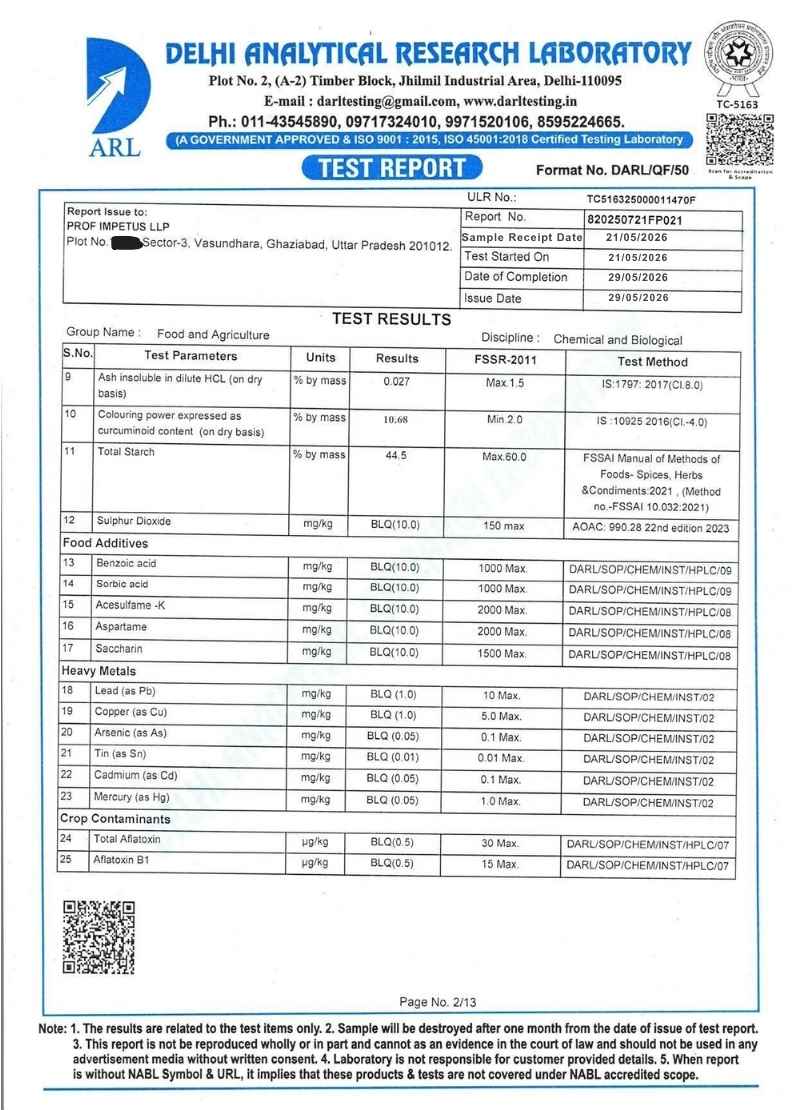
- Laboratory testing. Curcumin content is measured by analytical methods such as high-performance liquid chromatography (HPLC), and contaminants like heavy metals are measured by accredited labs — not by eye. A seller who publishes batch results is showing their working.
- A named, traceable source. Adulteration thrives in anonymous, multi-hand commodity chains. The shorter and more named the chain — a stated variety, district, village, cooperative — the fewer places for substitution.
- A GI tag, where it applies. For Lakadong, the Geographical Indication ties the name to its region of Meghalaya, which makes origin a checkable claim rather than just a word on a pouch.
- Realistic pricing. Genuine, single-origin, tested turmeric cannot sell at commodity-haldi prices. Suspiciously cheap "premium" turmeric usually isn't.
Purity, in other words, is proven by transparency and testing — not by a clever-looking glass of water.
Where our Lakadong fits
We do not ask you to take "pure" on faith. Our Lakadong is a single variety from a named place — Mulieh village in the Jaintia Hills, sourced through Padma Shri Trinity Saioo's farmer cooperative (Ministry of Food Processing Industries, n.d.) — and we publish the lab-tested curcumin figure for the batch we are selling (this batch: 10.68%; range across batches 7–12%). For more on the variety and how to recognise real Lakadong, see our guide to what Lakadong turmeric is; for what the curcumin percentage means and how it is measured, see curcumin percentage in turmeric. The current batch and sourcing details are on the Lakadong Turmeric page.
We make no health claims about turmeric. What we can stand behind is what is in the pouch, where it came from, and what the lab found.
Frequently Asked Questions
How can I check if my turmeric is pure at home?
You can run a few quick tests from India's FSSAI DART manual: an acid test for the banned dye metanil yellow (a lasting pink colour is a red flag), an acid test for chalk (fizzing), and a water-shake for lead chromate (separation or streaks). These tests can flag adulteration but cannot certify purity or measure curcumin — for that, lab testing is needed.
Is the turmeric "water test" reliable?
Not on its own. The common idea that pure turmeric leaves only a light yellow water is misleading, because pure turmeric also colours water and settles. A home water test can raise suspicion, but it cannot prove a powder is pure. Trusted sourcing and lab testing are the dependable checks.
What is turmeric adulterated with?
Most often with starch, chalk or spent turmeric (to add weight), the banned synthetic dye metanil yellow (to fake colour), or — most seriously — lead chromate, a toxic industrial pigment used to brighten dull powder (Forsyth et al., 2019).
Does a brighter colour mean better turmeric?
No. Colour is a weak guide and can be faked with dyes. A bright powder can be low in curcumin, and an unnaturally vivid yellow can signal added colour. Lab-tested curcumin content and a traceable source tell you far more than the shade.
How do I avoid adulterated turmeric?
Buy from a named, traceable source, prefer turmeric with a published batch test, be wary of suspiciously cheap "premium" claims, and treat colour alone as no guarantee. A GI tag, where it applies, makes origin checkable.
Set Maatru Rasah as a preferred source on Google
References
Food Safety and Standards Authority of India. (n.d.). DART: Detect adulteration with rapid test. Food Safety and Standards Authority of India, Ministry of Health and Family Welfare, Government of India.
Forsyth, J. E., Nurunnahar, S., Islam, S. S., Baker, M., Yeasmin, D., Islam, M. S., Rahman, M., Fendorf, S., Ardoin, N. M., Winch, P. J., & Luby, S. P. (2019). Turmeric means "yellow" in Bengali: Lead chromate pigments added to turmeric threaten public health across Bangladesh. Environmental Research, 179, 108722. https://doi.org/10.1016/j.envres.2019.108722
Hewlings, S. J., & Kalman, D. S. (2017). Curcumin: A review of its effects on human health. Foods, 6(10), 92. https://doi.org/10.3390/foods6100092
Magar, S. G., et al. (2021). Evaluation of curcumin content of turmeric accessions collected from North East India. Biological Forum – An International Journal, 13(3).
Ministry of Food Processing Industries, Government of India. (n.d.). PM FME e-newsletter — Lakadong turmeric and Trinity Saioo. https://pmfme.mofpi.gov.in/newsletters/enewsaugust6.html
In-text citations use APA author–date format. Forsyth et al. (2019) and FSSAI (n.d.) support the adulteration and testing facts; Hewlings & Kalman (2017) is cited only for composition (curcumin as turmeric's pigment), not for any health claim.
Disclaimer: This article is shared for educational and food-safety interest, drawing on cited sources. It is not medical or nutritional advice. Maatru Rasah products are foods, not medicines, and are not intended to diagnose, treat, cure, or prevent any disease. For any health concern, please consult a qualified professional.