
Lakadong turmeric is a high-curcumin variety of Curcuma longa grown in the Jaintia Hills of Meghalaya, in northeast India. It is a landrace — a regional variety, not a brand — prized because its curcumin runs far above ordinary turmeric, typically 7–12% against roughly 2–3%. It carries a Geographical Indication (GI) tag.
The turmeric most Indians have never actually tasted
Almost every Indian kitchen has a tin of haldi. Very few of us have tasted the turmeric that the rest of the world now writes about. That turmeric has a name and a place: Lakadong, from the Jaintia Hills of Meghalaya.
I went looking for it as a researcher before I ever sold it. What I found was not a marketing grade but a genuine variety, grown on hill slopes, cured slowly, and carried for generations by farming families in a corner of the northeast most spice buyers never visit. This is a plain guide to what Lakadong turmeric actually is — the variety, the place, the people, and how to tell the real thing from the many imitations now sold under its name. For the chemistry of curcumin and what the percentage means, that has its own guide, linked at the end.
What is Lakadong turmeric?
Lakadong is a landrace of turmeric — a regional variety shaped over generations in one place, the way Alphonso is a variety of mango or Basmati is a variety of rice. It takes its name from the Lakadong area of the Jaintia Hills in Meghalaya. It is not a brand, and it is not a processing "grade" that any turmeric can be upgraded into. A turmeric is Lakadong because of what it is and where it grew.
Its reputation rests on curcumin, the natural yellow-orange pigment in turmeric (Hewlings & Kalman, 2017). Where common commercial haldi usually carries only about 2–3% curcumin by weight — pure turmeric powder has been measured at an average of roughly 3.14% (Tayyem et al., 2006) — Lakadong runs far higher. Studies of turmeric grown in the northeast have recorded Lakadong and related accessions well above ordinary turmeric (Magar et al., 2021), and the variety is widely cited in the 7–12% range. We publish the lab-tested figure for the batch we are selling rather than a fixed number — our current batch tests at 10.68%. The full explanation of what that percentage means, and how it is measured, is in our companion guide to curcumin percentage in turmeric.
Where it comes from: the Jaintia Hills
Lakadong grows in the West Jaintia Hills District of Meghalaya, a high-rainfall region of hill slopes and iron-rich soil. The state has treated it as a flagship crop — the Government of Meghalaya's "Mission Lakadong" was set up to revive and scale its cultivation (Government of Meghalaya, n.d.).
Maatru Rasah sources its Lakadong from Mulieh village, through the farmer cooperative led by Padma Shri Trinity Saioo — the cultivator whose decades of work to revive Lakadong cultivation earned national recognition (Ministry of Food Processing Industries, n.d.). The cooperative draws on around 900 farmer households. We have stood in that field, eaten lunch with the farmers, and recorded their answers on a fieldwork audio recorder. That is the honest difference between our Lakadong and a generic "Meghalaya turmeric" sold without a named source: we can name the variety, the village, the cooperative and the tested batch.
Why this place grows turmeric this way
Three things stack up in the Jaintia Hills. The variety is a naturally high-curcumin landrace — that is its claim to fame. The place suits it: altitude, heavy rainfall, and acidic, mineral-rich hill soil. And the method is slow: the rhizomes are hand-harvested at maturity, hand-sliced, sun-dried rather than kiln-rushed, and ground at low temperature so the colour and aroma survive. These conditions are hard to reproduce on a mechanised plains farm, which is the honest reason real Lakadong stays uncommon — and priced accordingly.
What the GI tag means
Lakadong turmeric carries a Geographical Indication (GI) tag. A GI is a legal sign that ties a product's name to the specific region it comes from, in the same family of protections as Darjeeling tea or Kanchipuram silk (Geographical Indications Registry, India). For a buyer, the GI does one useful thing: it makes "Lakadong" a claim about origin that can, in principle, be checked — not just a word printed on a pouch.
It does not, by itself, prove that the powder in front of you is the real thing. That is where a little buyer's literacy helps.
How to tell real Lakadong from the imitations
Because the name carries a premium, ordinary turmeric is routinely relabelled and sold as "Lakadong." A few honest checks:
- Is the source named? Real Lakadong sellers can name the district, ideally the village and the cooperative. "Sourced from Meghalaya" with no further detail is a soft claim.
- Is there a batch test? Curcumin is measured in a laboratory, not by eye — a bright powder can still be low in curcumin, and colour can be faked. A seller who publishes a batch-tested percentage is showing their working.
- Is the price realistic? Hill-grown, hand-cured, single-origin turmeric cannot sell at commodity-haldi prices. A "Lakadong" sold suspiciously cheap usually isn't.
- Beware the label that does the work for you. A word on a pouch — "pure," "premium," even "organic" — is not the same as a named variety, a named village and a test. Ask for the specifics; a genuine seller has them.
- Colour and aroma, as a final sense-check. Real Lakadong is deep amber-orange with a strong, warm, peppery smell. Faded colour or a flat aroma is a bad sign — though on their own these prove little.
A note on tradition (not a health claim)
Turmeric has a long place in Indian kitchens and in classical texts. In Ayurvedic tradition, turmeric was described as a warming spice — ushna in classical classification (Pole, 2013) — and it appears in everyday preparations like haldi doodh, the turmeric milk many of us grew up with. We share this as cultural and culinary heritage, in third person, drawing on cited sources. It is not a promise about what turmeric does to your body. Maatru Rasah products are foods, not medicines (see the note at the foot of this article).
How to cook with Lakadong turmeric
Lakadong is more concentrated in colour and flavour than ordinary haldi, so use less — start with about a third to a half of what a recipe asks for, then adjust.
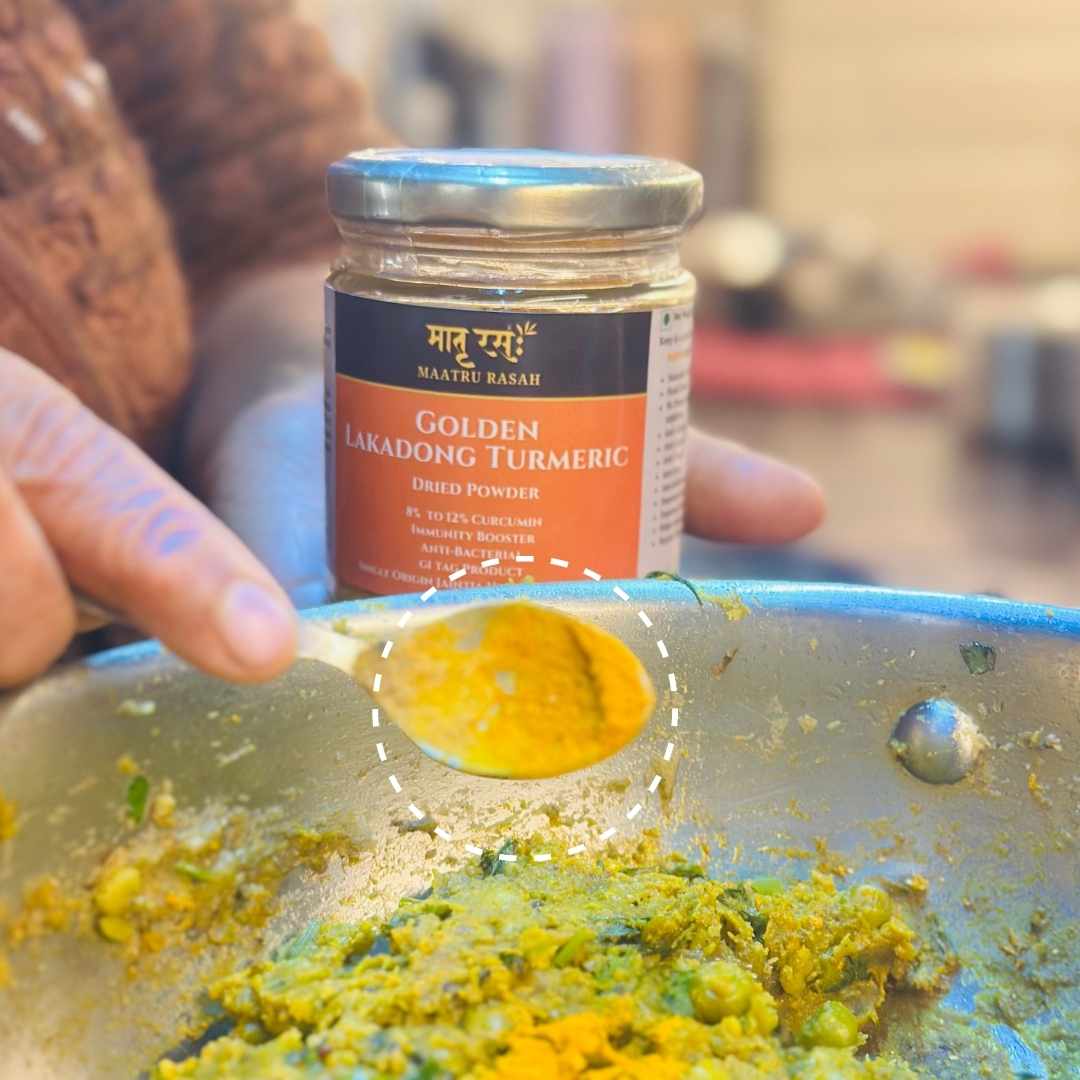
- Add it early, in fat. Stir it into hot ghee or oil at the start of a dish, in the tadka, rather than dusting it on at the end. It blooms into a deeper, more even gold that way.
- Everyday cooking. Dal, sabzi, khichdi, pulao, biryani, and marinades for paneer or fish — a small spoon carries a lot of colour.
- Haldi doodh (golden milk). Warm milk, a small pinch of Lakadong, a little jaggery, and a turn of black pepper for flavour. The classic turmeric milk.
- A golden infusion. Simmer a pinch with fresh ginger and a squeeze of lemon for a warm, golden cup.
Because it is so concentrated, a small 50 g pouch goes a long way in a home kitchen.
Where to go from here
If you want the science — what curcumin actually is, why Lakadong runs higher, and how the percentage is measured in a lab — read our guide to curcumin percentage in turmeric. If you want to see the current batch's tested figure, sourcing details and weights, that is on our Lakadong Turmeric page. The fuller sourcing story — Mulieh village and the Trinity Saioo cooperative — is on our About Us page.
Lakadong is not a miracle and we will not sell it as one. It is a very good turmeric from a real place, grown by named people, and honestly tested. For a cook who cares about colour and flavour, that is reason enough.
Frequently Asked Questions
What is Lakadong turmeric?
Lakadong turmeric is a high-curcumin landrace of Curcuma longa grown in the Jaintia Hills of Meghalaya. It is a variety rather than a brand, valued because its curcumin runs well above ordinary turmeric — typically 7–12% against roughly 2–3%. It carries a Geographical Indication (GI) tag.
Where is Lakadong turmeric grown?
It is grown in the West Jaintia Hills District of Meghalaya, in northeast India, around the Lakadong area. Maatru Rasah sources it from Mulieh village through the farmer cooperative led by Padma Shri Trinity Saioo.
How is Lakadong different from regular haldi?
Lakadong is a single-origin Meghalaya variety with markedly higher curcumin than common turmeric, which in the kitchen means deeper colour and fuller flavour from less powder. It is also GI-tagged, so its origin can be verified rather than just claimed.
How do I know my Lakadong turmeric is real?
Look for a named source (district, village, cooperative), a published batch test for curcumin, and a realistic price. A word like "pure" or "premium" on the pouch is not proof; a named variety, a named place and a lab figure are.
How do I use Lakadong turmeric?
Use about a third to a half of the turmeric a recipe calls for, since it is more concentrated. Add it early to hot ghee or oil so it blooms, and use it in dal, sabzi, khichdi, marinades, or in haldi doodh.
References
Geographical Indications Registry, Government of India. (n.d.). Geographical Indications of India: registered GIs. Office of the Controller General of Patents, Designs and Trade Marks.
Government of Meghalaya, Directorate of Agriculture. (n.d.). Mission Lakadong. https://www.megagriculture.gov.in
Hewlings, S. J., & Kalman, D. S. (2017). Curcumin: A review of its effects on human health. Foods, 6(10), 92. https://doi.org/10.3390/foods6100092
Magar, S. G., et al. (2021). Evaluation of curcumin content of turmeric accessions collected from North East India. Biological Forum – An International Journal, 13(3).
Ministry of Food Processing Industries, Government of India. (n.d.). PM FME e-newsletter — Lakadong turmeric and Trinity Saioo. https://pmfme.mofpi.gov.in/newsletters/enewsaugust6.html
Pole, S. (2013). Ayurvedic medicine: The principles of traditional practice. Singing Dragon.
In-text citations use APA author–date format. Hewlings & Kalman (2017) is cited only for composition facts (turmeric as the dietary source of curcumin), not for any disease or treatment claim. Pole (2013) is cited only for traditional/cultural classification, not as efficacy.
Disclaimer: This article is shared for cultural and educational interest. It describes culinary and Ayurvedic traditions as heritage, drawing on cited sources. It is not medical or nutritional advice. Maatru Rasah products are foods, not medicines, and are not intended to diagnose, treat, cure, or prevent any disease. For any health concern, please consult a qualified professional.