
Aam ka achar is India's traditional mango pickle: pieces of sour raw mango (kairi) cured with salt, spices and usually mustard oil, then left to mature. The salt and oil draw out water and seal out air, which is how a well-made jar keeps for a year without any artificial preservative.
The jar that outlives the summer
There is a particular smell that lives in Indian kitchens around April and May. Sharp mustard oil, the warm dust of roasted fenugreek, the green bite of raw mango cut that morning. In the Agarwal family kitchen in Katra, Prayagraj, that smell has signalled the same thing for generations: the mangoes are sour and firm, the sun is high, and it is time to make the achaar that the family will eat all year.
Aam ka achar is not a condiment you make on a Tuesday because you feel like it. Real mango pickle is tied to a single season. The mango has to be caught young, before the sugar arrives and the flesh softens. Miss that window and you wait twelve months. That constraint is the whole story, and most of what makes traditional mango pickle interesting follows from it.
This guide is for anyone who has eaten aam ka achar their whole life and never quite known what is happening inside the jar. What it is, where it came from, why it lasts, what each ingredient is actually doing, and how to tell a pickle made with care from one made on a factory line. We make six mango achaars ourselves, so we will be honest about where our own jars sit in that picture.
What is aam ka achar, really?
Aam ka achar is mango pickle made from raw, unripe mango. The mango is cut into pieces, salted, mixed with a spice blend, and in most regional styles combined with oil, then left to mature for days or weeks until the flavours marry and the mango softens into something tart, salty and intense.
The Hindi word "achar" (also spelled achaar) describes a food preserved in salt, oil, spice or a sour medium. "Aam" is mango. So aam ka achar literally means "mango's pickle." The mango used is "kairi" — the green, hard, mouth-puckering fruit, not the sweet ripe mango you eat in June.
That single choice, sour mango instead of sweet, is doing quiet work. Unripe mango is high in acid and low in sugar, and both of those conditions make life difficult for the microbes that spoil food. The pickle is partly delicious and partly a small, edible piece of food-preservation engineering that Indian kitchens worked out long before anyone could explain why it worked.
A short history: from clay martabans to the Katra courtyard
Pickling is one of the oldest food technologies in the subcontinent. Long before refrigeration, the problem every Indian household faced was the same: a few weeks of glut followed by months of scarcity. Salt, oil and sun were the answer. Raw mango, lemon and a range of vegetables were salted, spiced and sealed into glazed clay jars — the "martaban" — and stored to be eaten through the lean months.
Mango pickle in particular has deep roots in classical Indian writing. As the food historian K. T. Achaya documents, Sanskrit and early Tamil literature describe pickled and preserved foods among everyday lists, and the mango is woven through the subcontinent's food history for well over a thousand years (Achaya, 1994). The word "achar" itself is usually traced to Persian, arriving with centuries of culinary exchange and settling into nearly every Indian language.
What makes mango achaar feel less like a recipe and more like an inheritance is that it was rarely written down. It was watched, tasted and corrected. A grandmother's hand decided how much salt, a mother's nose decided when the oil was hot enough, and the proportions lived in memory rather than on paper.
The Agarwal family kitchen since 1857
Our own mango recipes come from exactly that kind of transmission. They are recipes from the Agarwal family kitchen in Katra, Prayagraj, carried within the family since 1857 — a lineage of method and proportion handed down rather than published. To be precise about it: 1857 is the age of the recipes, not the company. Maatru Rasah is the modern kitchen that makes them, incorporated as Prof Impetus LLP in 2013. We keep that distinction clear because heritage claims should be checkable, not decorative.
Today those recipes are cooked by our head cook, Uma Agarwal, who has more than forty years at the stove. The proportions still are not really written down in the way a packaged-food company would write them. They are in her hands.
The food science of how a mango pickle survives a year
Here is the part most people never get told. A good aam ka achar is shelf-stable for months, often a full year, with no chemical preservative at all. That is not magic and it is not luck. It is four old techniques stacked on top of each other, and each one removes a different thing that microbes need to grow. We will keep this light, but where we state something as fact, we will point to the research.
Salt and osmosis — pulling out the water
The first thing salt does is pull water out of the mango. Microbes need available, "free" water to grow, measured by food scientists as "water activity". Salt lowers it. As salt dissolves into the moisture on and inside the mango, water moves out of the fruit by osmosis and becomes chemically unavailable to bacteria and moulds. Drop the water activity far enough and most spoilage organisms simply cannot function. This is the same principle behind salt-cured fish and meat, and it is well documented in food-preservation science (Institute of Medicine, 2010).
It is worth being honest about the limit, though. Salt makes spoilage much harder; it does not make a food sterile by itself. Some salt-tolerant microbes survive high-salt conditions, which is exactly why traditional pickling never relies on salt alone — it adds oil, acid, spice and clean handling on top (Kim et al., 2017). Stacking the defences is the whole craft.
Oil — the barrier against air
In oil-based achaar, the mango pieces sit under a layer of oil. That layer is doing something specific: it seals the surface off from oxygen. Most of the moulds that ruin a pickle are aerobic — they need air. Submerge the mango under oil and you take that air away, while also blocking new moisture from getting in. This is why your grandmother always told you to keep the pieces pushed down under the oil and to use a dry spoon. A clean jar with the mango fully covered is a jar where the common spoilage moulds struggle to get a foothold.
There is a second reason Indian kitchens reach for mustard oil in particular, which we will come to under ingredients.
Acidity and the sour-mango advantage
Raw mango is genuinely sour because it is acidic, and acidity is a preservative in its own right. A low-pH environment is hostile to many bacteria. By choosing unripe kairi rather than sweet ripe mango, the traditional recipe starts from an ingredient that is already tilted against spoilage — high acid, low sugar. The pickle then gets more acidic still as it matures, because of the next process.
Where fermentation fits in
Many traditional Indian pickles, including mango brine styles, undergo a gentle lactic-acid fermentation in their early days. Naturally present lactic acid bacteria feed on the small amount of available sugars and produce acids that lower the pH further, sharpen the flavour and add another layer of protection. Researchers studying traditional Indian pickles have repeatedly isolated lactic acid bacteria from them and documented this souring (Monika et al., 2017; Ragul et al., 2020). Crucially, a moderate salt level — roughly the range traditional recipes use — selects "for" these helpful bacteria while holding back spoilage organisms. The salt is not just drying the mango; it is curating which microbes get to live in the jar.
A careful note: that some of these bacteria are studied for probiotic properties is interesting food science, not a health promise. We do not make medical claims about our achaar, and you should be sceptical of any pickle brand that does.
So: salt removes the water, oil removes the air, sour mango and fermentation keep it acidic. Four defences, no preservative. That is the engineering hiding inside an ordinary jar.
Ingredient by ingredient: what's actually in the jar
Ramkela kairi — why a sour, firm mango
Not every mango makes good pickle. You want a variety that is sour, firm, and holds its shape after salting and curing. In the north, the classic pickling mango is the "Ramkela" — a raw mango prized precisely because it stays firm and tart and does not turn to mush. We use Ramkela kairi for our mango achaars for that reason. A sweet, soft mango would collapse and ferment the wrong way; the firm sour one survives the process and rewards it.
Mustard oil, and why "kachi ghani" matters
Across north and eastern India, the default oil for achaar is mustard oil, and there is logic to it beyond taste. Mustard carries compounds — chiefly allyl isothiocyanate, the molecule responsible for that sharp sting in your nose — that have documented antimicrobial activity against a broad range of bacteria and fungi (Dai & Lim, 2014). In other words, mustard oil is not a neutral cooking medium in a pickle. It is part of the preservation system and part of the flavour at the same time.
The grade of oil matters too. "Kachi ghani" means cold-pressed, or wood-pressed — oil crushed at low temperature so its pungency and aromatic compounds survive rather than being stripped by heat and refining. We use wood-pressed (kachi ghani) mustard oil in our oil-based mango achaar for exactly that reason. We have written a separate, deeper piece on the wood-pressed (kachi ghani) mustard oil tradition if you want the full story of how the oil itself is made. Read "Why Kachi Ghani Is the Only Mustard Oil for Aam Ka Achaar"
The masala: fenugreek, fennel, nigella, mustard seed, turmeric, asafoetida
The spice blend is where regional and family identity lives. The northern mango-achaar masala is built on a recognisable cast: "methi" (fenugreek), "saunf" (fennel), "kalonji" (nigella seeds), "rai" (split mustard seeds), "haldi" (turmeric) and a little "hing" (asafoetida). Beyond flavour, several of these spices are aromatic and contribute their own mild antimicrobial character, and turmeric gives the pickle its deep ochre colour. The blend is toned to the household; ours is toned to a Prayagraj palate.
Kala chana, sendha namak, desi khand — the variant-makers
A few additions turn a base mango achaar into a distinct style:
- Kala chana (black chickpeas) add body and a nutty, slow-soaked texture to the pickle. Our flagship Tailam Aamra is built around kala chana with wood-pressed mustard oil — an uncommon combination that gives it a character most mango pickles do not have.
- Sendha namak (rock salt) replaces common salt in fasting styles. Our Phalahari Aamra uses sendha namak and is made oil-free, with no onion and no garlic, so it suits vrat and phalahari rules.
- Desi khand (unrefined sugar) brings the sweet-tangy balance of a khatta meetha style. Our Khatta Meetha mango achar uses desi khand rather than refined sugar, which is why it tastes rounded rather than flatly sweet.
The point is that "mango pickle" is not one thing. The mango is the constant; salt, oil, sweetness and additions like chana are the dials, and different families and regions set them differently.
How traditional mango pickle is made (method overview)
You do not need to be a cook to understand the shape of the process. Here is the method in outline — not a full recipe, but enough to see what is happening at each step:
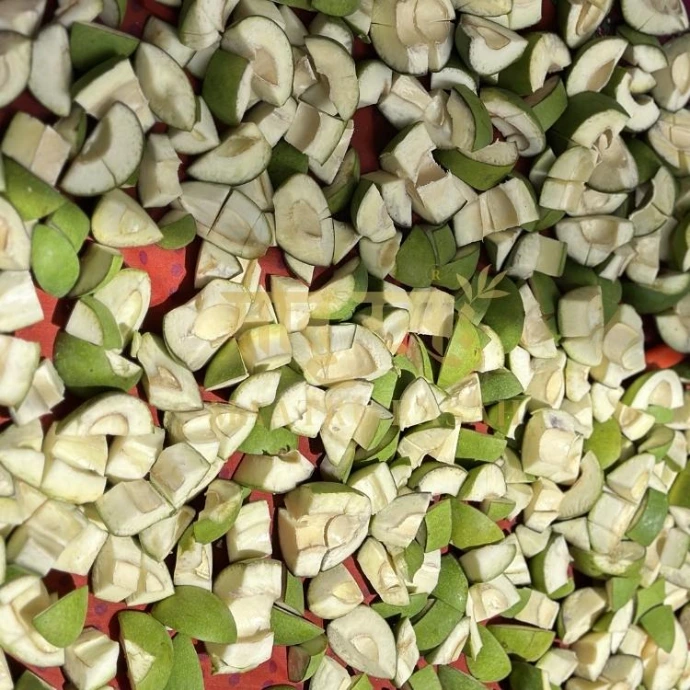
1. Cut and dry the kairi. Raw mango is washed, cut into pieces, and surface-dried completely. Any free water on the mango is an invitation to mould, so this step is not optional.
Ramkela raw mango (kairi) cut for aam ka achar
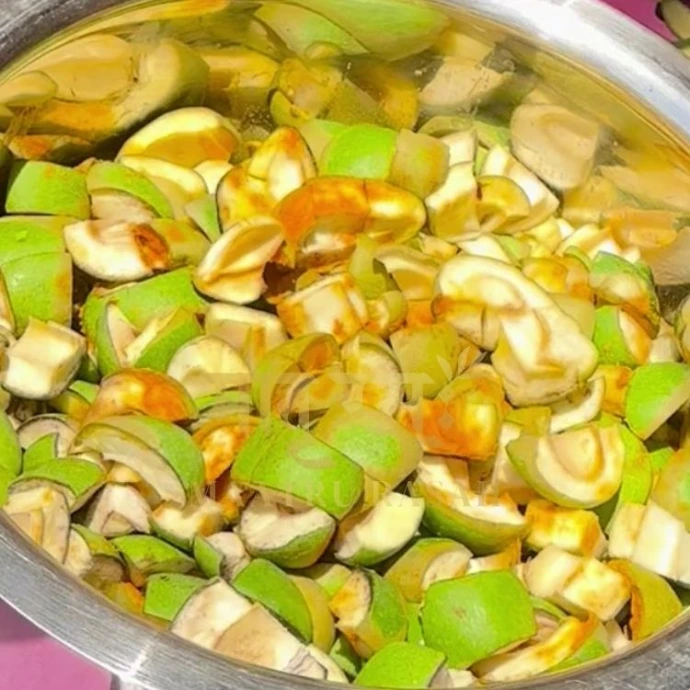
2. Salt it. The pieces are mixed with salt and usually rested. Osmosis begins; water leaves the mango.
3. Sun-cure. The salted mango is left in the sun, often for days. Sunlight and warmth drive off more moisture and kickstart the early souring.
Salted mango pieces
sun-curing for mango achaar
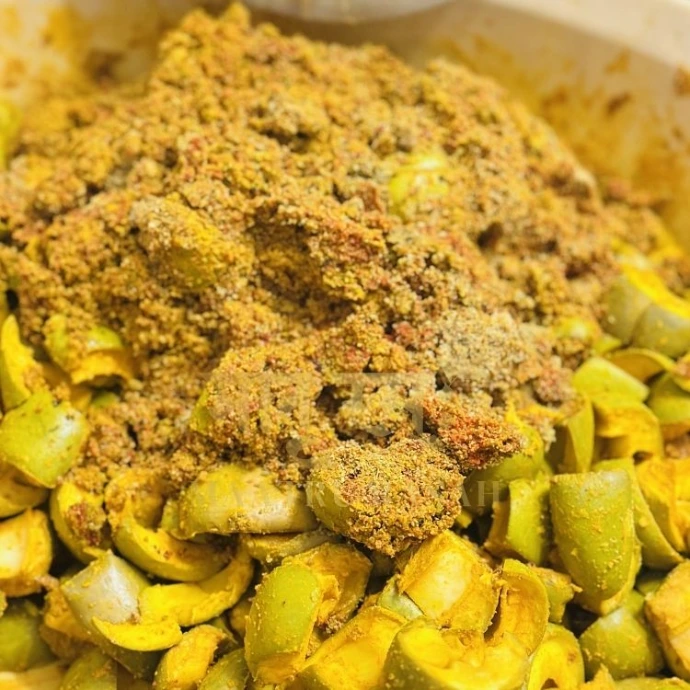
4. Add the masala. The dried spice blend is mixed through.
5. Add oil (in oil styles). Mustard oil is heated, cooled, and poured over until the pieces are submerged.
Achaar masala
of fenugreek, fennel, nigella and mustard seed
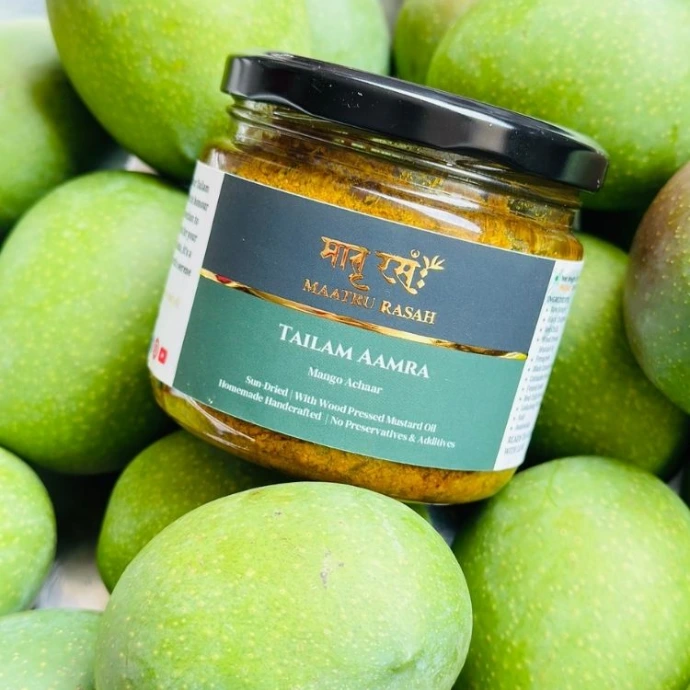
6. Mature. The jar rests, sometimes turned in the sun, while flavours marry and acidity develops.
7. Store under oil. Kept covered, dry-spooned and cool, the pickle holds for months.
Tailam Aamra mango
achaar with kala chana in wood-pressed mustard oil
For Tailam Aamra specifically, that sun-cure runs a full 21 days, and the whole batch is made just once a year, when the season's Ramkela kairi arrives. If you want the complete, measured version you can cook at home, we have written the full step-by-step aam ka achar recipe separately.
The regional map of Indian mango pickle
There is no single Indian mango pickle. Each region solved the same problem with its own ingredients and climate, and the results are genuinely different foods.
| Region | Signature mango pickle | What sets it apart |
|---|---|---|
| Uttar Pradesh / Prayagraj | Classic oil-and-spice aam ka achar | Mustard-oil base, fenugreek-forward masala, often sun-cured; our family style |
| Andhra Pradesh | Avakaya | Heavy on red chilli and ground mustard, generous oil, fierce heat |
| Gujarat | Chhundo (chunda) | Sweet, grated mango cooked or sun-cured with sugar — sweet rather than savoury |
| Punjab | Punjabi aam da achar | Robust whole-spice masala, hearty mustard-oil cure |
| Rajasthan | Dry and oil-light styles | Adapted to a hot, dry climate; less oil, more sun |
The split that matters most for buyers is oil versus oil-free. Oil-
The split that matters most for buyers is oil versus oil-free. Oil-based achaar uses the oil layer as a preservative and tends to keep longest. Oil-free styles lean harder on salt, acidity and careful drying, which is why they often taste sharper and need more attention in storage. We make both: the oil-based, kala-chana Tailam Aamra on one side, and oil-free styles like the cumin-led Jeerkam Aamra and the vrat-friendly Phalahari Aamra on the other.
Traditional vs commercial mango pickle
Not all mango pickle is made the same way, and the differences are easy to taste once you know what to look for. This is a comparison of approaches, not an attack on any brand.
| Traditional / small-batch | Typical mass-market | |
|---|---|---|
| Preservatives | None; relies on salt, oil, acid, sun | Often acetic acid, sodium benzoate or other added preservatives |
| Oil | Wood-pressed (kachi ghani) common | Refined oil, chosen for cost and neutrality |
| Mango | Seasonal, variety-specific (e.g. Ramkela kairi) | Whatever is available and cheap year-round |
| Batch | Small; tied to the mango season | Large, continuous, year-round |
| Sweetener (in sweet styles) | Desi khand / jaggery | Refined sugar or syrup |
| Consistency | Varies slightly batch to batch | Standardised |
Neither column is "wrong" — mass production solves real problems of scale and price. But if you are paying for tradition, these are the markers worth checking. For the record, our achaar carries no artificial preservatives, is made in small batches of roughly 300 to 500 jars a month in our our kitchen, is licensed under FSSAI (12723052000504).
The six mango achaars we make
If you want to taste the tradition rather than read about it, here is our mango shelf. They share the same Ramkela-kairi base and family masala; the dials are set differently on each.
| Achaar | Style | What makes it distinct |
|---|---|---|
| Oil-based, kala chana, wood-pressed mustard oil, 21-day sun-cure | Our flagship; the only one with black chickpeas; made once a year | |
| Jeerkam Aamra | Oil-free, cumin (jeera) | Lighter, cumin-forward, no oil |
| Mirchauni Aamra | Oil-free, spicy red chilli | The hot one, without oil |
| Pachranga Aamra | Oil-free, five-spice (panchranga) | Five-spice character; a different product from the mass-market Pachranga Foods brand |
| Khatta Meetha | Sweet-tangy, desi khand | Rounded sweet-and-sour from unrefined sugar, not refined |
| Phalahari Aamra | Oil-free, sendha namak, vrat-friendly | Rock salt, no onion, no garlic — made for fasting days |
You can browse all six on our Mango Achaar category, or start with Tailam Aamra if you want the fullest expression of the family recipe.
Myths and facts about aam ka achar
Myth: "Oil floating on top means the pickle has gone bad."
Fact: the opposite, usually. That oil layer is the seal keeping air off the mango. A pickle sitting properly under its oil is a pickle being protected. What you actually watch for is mango pieces poking *above* the oil and drying out, or a fuzzy mould growth — not the oil itself.
Myth: "A white or fuzzy layer is normal, just scrape it off."
Fact: a fuzzy or coloured mould growth means air, moisture or a wet spoon got in, and that batch is compromised. Prevention is simple: dry the mango fully before pickling, keep pieces submerged under oil, always use a dry spoon, and keep the jar cool. Traditional handling is mostly about denying mould the water and air it needs.
Myth: "More salt makes pickle healthier."
Fact: salt is there to preserve, not to be healthy. Traditional recipes use the salt level the preservation needs, no more. Mango pickle is a high-salt, high-oil food eaten in small spoonfuls as a relish — that is the honest way to enjoy it, and we will not pretend otherwise.
Myth: "Traditional pickle can't be safe without preservatives."
Fact: well-made traditional pickle is shelf-stable precisely because salt, oil, acidity and drying each remove something microbes need. The science is real and old. What matters is that it is made carefully and handled cleanly — not that a chemical was added.
Myth: "Is mango pickle good for your health?"
Fact: this is where we stop and tell you the truth. We do not make health or medical claims about our achaar, and Indian food regulations rightly restrict such claims. Mango pickle is a traditional, flavourful, salt-and-oil-preserved relish. Enjoy it for what it is — taste and heritage — in sensible amounts. Anyone selling you a pickle as a cure is selling you a story.
Frequently Asked Questions
What is aam ka achar?
Aam ka achar is India's traditional mango pickle, made from sour raw mango (kairi) cut into pieces and cured with salt, a spice blend, and usually mustard oil. It is left to mature until tart, salty and intense, and a well-made jar keeps for months without artificial preservatives.
What is aam ka achar made of?
The core is raw, unripe mango (kairi), salt and a spice blend — typically fenugreek, fennel, nigella, split mustard seed, turmeric and asafoetida. Most styles add mustard oil. Variants add black chickpeas (kala chana), rock salt (sendha namak) for fasting, or unrefined sugar (desi khand) for a sweet-tangy taste.
Why is mustard oil used in mango pickle?
Mustard oil does two jobs at once. It seals the mango from air, which blocks the moulds that need oxygen, and it carries allyl isothiocyanate, a mustard compound with documented antimicrobial activity. It also gives north Indian achaar its characteristic pungency. Wood-pressed (kachi ghani) mustard oil keeps these compounds best.
Which mango is used for pickle in India?
A sour, firm raw mango that holds its shape after salting. In north India the classic choice is the Ramkela variety, prized because it stays firm and tart rather than turning soft. Sweet, ripe mango is not used — it is too low in acid and too high in sugar to preserve well.
How long does mango pickle last?
An oil-based mango pickle, kept with the pieces submerged under oil and handled with a dry spoon, commonly keeps for around a year at room temperature. Oil-free styles are more delicate and are best kept cool and eaten sooner. Moisture and a wet spoon are the main causes of spoilage.
Is mango pickle made only once a year?
Traditional mango achaar is tied to the raw-mango season, so it is genuinely made in one annual window when sour, firm kairi is available. Our Tailam Aamra, for example, is made once a year. This is why small-batch mango pickle can go out of stock and is not produced continuously like a factory product.
Why does mango pickle sometimes grow a white or fungus layer, and how do I prevent it?
A mould layer means air, moisture or a wet spoon reached the mango. Prevent it by drying the mango completely before pickling, keeping the pieces fully submerged under oil, always using a clean dry spoon, and storing the jar cool. The oil seal and dryness are what keep mould out.
Is mango pickle good for health?
We do not make health or medical claims about our achaar, and we would be cautious of any brand that does. Mango pickle is a traditional, salt-and-oil-preserved relish meant to be enjoyed in small amounts for its flavour and heritage. Treat it as a tasty relish, not a health product.
Tasting the tradition
Everything about aam ka achar comes back to that short, sour window in the spring when the kairi is right. The salt, the oil, the sun, the waiting — they are all answers to the question of how to keep a season alive for a year. That our family has been answering it the same way, with recipes carried from the Agarwal kitchen in Katra since 1857, is the part we are proudest of.
If you would like to taste it, browse our six mango achaars or begin with Tailam Aamra, the kala-chana, wood-pressed, once-a-year jar that is the fullest expression of the family recipe.
New to mango pickle, or just curious? Here's what aam ka achar actually is — the cut, the cure, and the tradition behind it.
Set Maatru Rasah as a preferred source on Google
References
Achaya, K. T. (1994). Indian food: A historical companion. Oxford University Press.
Dai, R., & Lim, L.-T. (2014). Release of allyl isothiocyanate from mustard seed meal powder. Journal of Food Science, 79(1), E47–E53. https://doi.org/10.1111/1750-3841.12322
Institute of Medicine. (2010). Strategies to reduce sodium intake in the United States (J. E. Henney, C. L. Taylor, & C. S. Boon, Eds.). National Academies Press. https://www.ncbi.nlm.nih.gov/books/NBK50952/
Kim, N. H., Cho, T. J., & Rhee, M. S. (2017). Sodium chloride does not ensure microbiological safety of foods: Cases and solutions. Advances in Applied Microbiology, 101, 1–47. https://doi.org/10.1016/bs.aambs.2017.05.001
Monika, Savitri, Kumar, V., Kumari, A., Angmo, K., & Bhalla, T. C. (2017). Isolation and characterization of lactic acid bacteria from traditional pickles of Himachal Pradesh, India. Journal of Food Science and Technology, 54(7), 1945–1952. https://doi.org/10.1007/s13197-017-2629-1
Ragul, K., Kandasamy, S., Devi, P. B., & Shetty, P. H. (2020). Safety and stability assessment of potential probiotic strains from fermented mango brine pickle. Probiotics and Antimicrobial Proteins, 12(3), 1039–1044. https://doi.org/10.1007/s12602-019-09617-7