
Store turmeric airtight, cool, dark and dry. In the monsoon the thing to watch first is moisture, and after that, ghun. Haldi resists weevils better than most spices, but damp air still makes it cake and lose its colour and smell, and a humid rasoi can invite ghun from grain kept nearby. A dry spoon, a sealed barni, and a few old kitchen habits keep it safe.
A spice that cost more deserves a better shelf
Every monsoon, a good spice quietly goes dull in a damp jar. Nobody notices the day it happens. The haldi just slowly stops being as good as the day you brought it home.
This is a plain guide to keeping turmeric well through the wet months. It matters more when the turmeric is a single-origin, high-curcumin one like Lakadong, because there is more to lose. I will keep it simple. What actually harms haldi, whether it really gets ghun, and the small habits my mother's kitchen never skipped.
Does turmeric really get ghun?
Haldi resists ghun better than most spices. The same compounds that make turmeric what it is, curcumin and its aromatic oils, also keep many storage insects away. Researchers who study grain storage have looked at these turmeric compounds as natural protectants for stored cereals (United States Department of Agriculture, Agricultural Research Service, 2019; Hewlings & Kalman, 2017).
There is an old irony here. In many Indian homes a little haldi was mixed into stored grain to keep ghun out of the wheat, not because the haldi itself was the easy target. So turmeric has long stood on the defending side.
That does not mean your haldi can never get ghun. In a humid rasoi, or when it sits next to atta, sooji or whole spices that are already infested, the insects travel across. The jar of turmeric is rarely where ghun begins. It is where ghun wanders in. That distinction decides how you store it.
The bigger monsoon problem is moisture
Before ghun, worry about damp. Turmeric powder pulls water out of humid air, and once it does, the damage is quiet but real.
It cakes first. The free-flowing powder turns to hard lumps. Then it loses colour and smell, because the oils that carry turmeric's fragrance leave faster in warm, wet air. And it loses curcumin, the very thing you paid more for. If storage gets truly wet, spice powders can grow mould, which our food regulator lists as a real storage risk (Food Safety and Standards Authority of India, n.d.).
So storage is not a small matter for haldi. A commodity turmeric and a lab-tested Lakadong both suffer in the damp. With Lakadong you are simply watching a costlier thing lose the quality that made it worth choosing.
How to store turmeric in the monsoon
None of this needs anything special. A good jar and a few dry habits do most of the work.
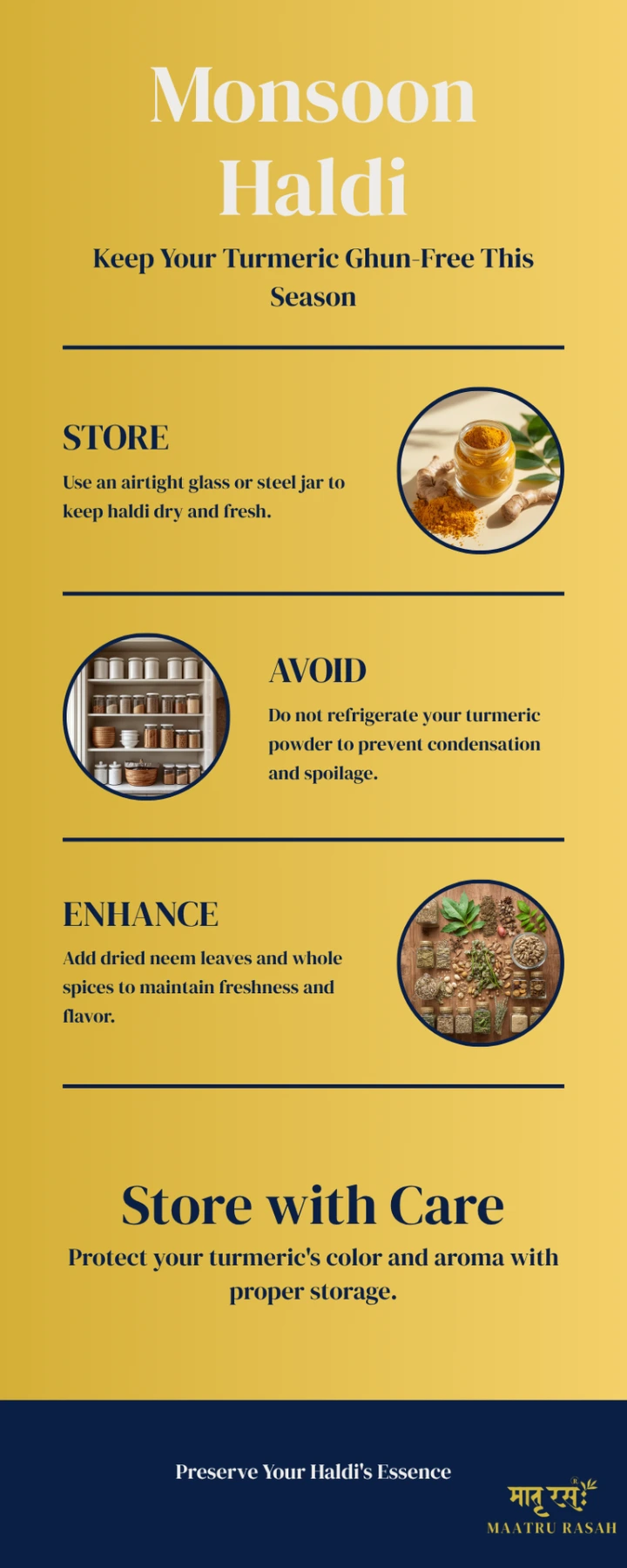
- A dry, airtight, non-plastic barni. Glass or food-grade steel with a tight lid. Keep plastic for the short term only, because it lets faint damp and smell pass and holds stains. A dark or opaque jar also keeps light off the curcumin.
- A cool, dark, dry shelf. Away from the stove, the sink, the window. Heat ages a spice. So does steam. So does sun. A closed cabinet answers all of them.
- Never a wet spoon. The most common way haldi spoils is a damp or oily spoon going into the jar. Keep one dry spoon for it, or pour instead of dip.
- A food-safe silica-gel sachet. The small food-grade kind, dropped into the jar, takes up stray damp. It is the cheapest monsoon insurance there is.
- Fill the jar, leave little air. Less air space means less trapped moisture. Move the powder to a smaller jar as the level drops.
- Keep the bulk sealed, use a small working jar. Store a quantity you will finish in a few months. Keep the main stock tightly closed and refill a small jar from it. Opening the whole stock again and again is what lets the damp in.
Do this, and haldi holds its colour and smell for many months. Skip it in a coastal or high-rain monsoon, and even good turmeric can turn dull in weeks.
Gharelu nuskhe: the old kitchen tricks for ghun
Before silica gel and airtight steel, our grandmothers already kept spices ghun-free. These tricks are traditional kitchen practice, not medicine, and many of them work because the insects dislike a strong smell. Use them with the storage habits above, not instead of them.
- Neem ke sookhe patte. A few dried neem leaves tucked into the tin. Neem's smell has long been used to keep stored-grain insects away, and it is one of the better-studied botanical repellents.
- Sabut laung. Three or four whole cloves in the jar. The sharp smell discourages ghun, and it does not pass into the haldi in any real way.
- Tejpatta. One or two dried bay leaves in the container, an old trick shared with how families protect atta and dals.
- Ek sookhi lal mirch. A dried red chilli kept in the jar, the way many homes still store rice and flour.
- Hing ki khushboo. A small piece of asafoetida, wrapped, near the spice tins. Its strong smell is traditionally trusted to keep insects off a whole shelf.
- Dhoop, halki. If a jar has taken slight damp, a short airing in shade or gentle morning sun dries it. Keep it brief, because strong sun fades turmeric's colour.
- Grain se door rakho. Store haldi away from open atta, sooji and whole spices. Ghun usually breeds there first and then travels. This one habit prevents most turmeric infestations.
- Bade stock ke liye, seal karke thanda. For a large quantity, keep it tightly sealed and cold, and bring a small portion to room temperature in its own jar for daily use. Sealed and cold slows both damp and insects, as long as the cold jar is never opened straight into humid air.
My mother kept a few laung and a neem leaf in the haldi barni every monsoon, and checked the lid was dry before she set the stone back on it. It was habit, not ritual. The haldi stayed good, and that was proof enough for her.
Why this matters more for Lakadong
Lakadong is a single-origin turmeric from the Jaintia Hills of Meghalaya, and it carries an unusually high curcumin content. The figure commonly sits in the 7–12% range, and the batch we sell now tested at 10.68% (Ministry of Food Processing Industries, n.d.). That is the reason it costs more than ordinary blended haldi, and it is the first thing damp storage takes away.
So the care is not fuss. The more you paid for the curcumin, the more careful storage protects what is already in your jar.
If you want the background instead of the storage, we keep it separate. What the variety is, in what Lakadong turmeric is. What the number means, in curcumin percentage in turmeric. How to spot a fake, in is your turmeric pure. The batch we are selling now, with its tested figure and sourcing, is on the Lakadong Turmeric page, part of our GI-Tagged Spices.
Myths and clarifications
- "Keep it in the fridge to be safe." Not for the powder you use daily. A cold jar coming out into warm, humid air forms water inside, which is the exact damp you are trying to avoid. A cool, dry cupboard is better.
- "Sun it now and then to freshen it." Strong sun fades curcumin and drives off the smell. If a jar has taken slight damp, a brief airing in shade is gentler than an hour in the sun.
- "Ghun in the jar means the haldi is natural." Insects are a storage and hygiene sign, not a purity certificate. Purity is about what is in the powder, a different question, covered in the purity guide above.
- "A little caking is fine, just crush it." You can break the lumps, but caking means damp has already got in. Fix the storage, or the smell keeps leaving.
Frequently Asked Questions
Haldi ko ghun se kaise bachayein?
Keep it in a dry, airtight glass or steel barni, in a cool, dark, dry place, and always use a dry spoon. Add a few dried neem leaves or whole cloves, and a food-grade silica-gel sachet. Most important, store haldi away from open atta or whole spices, because ghun usually starts there and travels to the turmeric.
Does turmeric actually get weevils (ghun)?
Rarely on its own. Turmeric's natural compounds keep most storage insects away, and it has even been used to protect stored grain from ghun. Insects seen near haldi usually come from an infested neighbour like flour or whole spices, so keep it sealed and separate.
Why does my turmeric powder turn hard and clump?
It has taken moisture from humid air, a damp spoon, or steam near the stove. Clumping is the first sign the colour and smell are being lost. A dry airtight jar, a dry spoon and a silica-gel sachet prevent it.
How long does turmeric powder last if stored well?
Kept airtight, cool and dry, it stays good for a long time, though it is most fragrant and bright within several months of grinding. Age alone rarely makes it unsafe, but flavour and colour fade, so buy an amount you will use.
Should I keep turmeric in the fridge?
For daily-use powder, no. Taking a cold jar in and out of humid monsoon air forms water inside. A sealed jar in a cool, dark cupboard is better. Only large sealed stock benefits from cold, and even then it must not be opened straight into damp air.
Key takeaways
- Moisture is the first monsoon problem for haldi. It causes caking, loss of colour and smell, loss of curcumin, and in very damp storage, mould.
- Turmeric resists ghun better than most spices. Ghun near a haldi jar usually travels in from infested atta or whole spices.
- Store it airtight, cool, dark and dry, in glass or steel, with a dry spoon and a silica-gel sachet.
- Old gharelu nuskhe help: neem patte, laung, tejpatta, a dried chilli, and keeping haldi away from open grain.
- The higher the curcumin you paid for, as with single-origin Lakadong, the more careful storage protects it.
Conclusion
In my mother's kitchen, spices were never left to chance in the monsoon. The good ones were sealed, kept dry, and treated as though they had cost something, because they had. Haldi asks for very little. A clean dry barni, a dry spoon, a neem leaf if you have one. Give it that, and a good turmeric keeps its colour and its smell long after the rain has gone.
Disclaimer: This article is shared for educational and practical kitchen interest, drawing on cited sources. It is not medical or nutritional advice. Maatru Rasah products are foods, not medicines, and are not intended to diagnose, treat, cure, or prevent any disease. For any health concern, please consult a qualified professional.
References
Food Safety and Standards Authority of India. (n.d.). Guidance on safe storage and handling of spices and condiments. Food Safety and Standards Authority of India, Ministry of Health and Family Welfare, Government of India.
Hewlings, S. J., & Kalman, D. S. (2017). Curcumin: A review of its effects on human health. Foods, 6(10), 92. https://doi.org/10.3390/foods6100092
Ministry of Food Processing Industries, Government of India. (n.d.). PM FME e-newsletter — Lakadong turmeric and Trinity Saioo. https://pmfme.mofpi.gov.in/newsletters/enewsaugust6.html
United States Department of Agriculture, Agricultural Research Service. (2019). Brassica nigra and Curcuma longa compounds affecting stored-product insects. USDA ARS. https://www.ars.usda.gov/